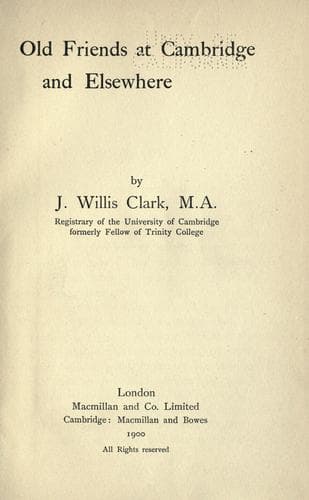
Old Friends at Cambridge and ElsewhereClark, John Willis
History
Old Friends at Cambridge and Elsewhere
Clark, John Willis
University of Cambridge -- History
Milnes had been called a Liberal-Conservative during the first ten years
of his parliamentary life. He now became a Conservative-Liberal; but the
transposition of the adjective made little, if any, change in his
political conduct. He was as insubordinate in the latter position as he
had been in the former. He took Lord Palmerston as his leader and chosen
friend; but he did not always side with him. In the debates on the
Conspiracy Bill, after the attempt of Orsini to assassinate Napoleon
III., Milnes spoke and voted against his chief; and on the measure for
abolishing the East India Company he was equally indifferent to the
claims of party. As time went on, he drifted out of party politics
altogether; and both in the House of Commons and the House of Lords,
which he entered in 1863, it was to measures of a private character, or
to measures of social reform, that he gave his attention. He advocated
help to Lady Franklin in her expedition to clear up the mystery of her
husband’s fate; he was in favour of female suffrage; of the abolition of
public executions; and he led the agitation for legalising marriage with
a deceased wife’s sister. At the same time he cordially supported the
Liberal party on all great occasions. Speaking of the abortive Reform
Bill of 1866, Mr Reid remarks:
‘Houghton held strongly to the Liberal side throughout the movement, and
again afforded proof of the fact that his elevation to the House of
Lords had strengthened, rather than weakened, his faith in the people
and in popular institutions. Early in April he presided at one of the
great popular meetings in favour of Reform. The scene of the meeting was
the Cloth Hall at Leeds—a spot famous in the political history of the
West Riding—and Lord Houghton’s speech was as advanced in tone as the
most thoroughgoing Reformer could have wished it to be. He was, indeed,
one of the very few peers who took an open and pronounced part in the
agitation of the year’ (vol. ii. p. 151).
This is only one instance, out of many that could be adduced. It would
be interesting to know what he would have thought of some of the later
developments of his party. It is almost needless to say that he never
regarded Lord Beaconsfield as a serious politician. On the eve of his
return from Berlin in 1878, he writes: ‘I hope to be in my place on
Thursday, to see the reception of the Great Adventurer. Whether from
knowing him so well, or from the sarcastic temperament of old age, the
whole thing looks to me like a comedy, with as much relation to serious
politics as Punch to real life.’ At the same time he had not been a
thoroughgoing supporter of Mr Gladstone’s agitation against the Turks,
and he had warned that statesman so far back as 1871, that ‘a demon, not
of demagoguism, but of demophilism, is tempting you sorely.’
Public-domain text, read in full here on John Shaqi.
Reviews
Reviews
No reviews yet
Be the first to share your thoughts on this work.
Elsewhere in the archive
Join the Discussion
Join the discussion
Sign in to leave a comment or review.
Sign InorCreate an account