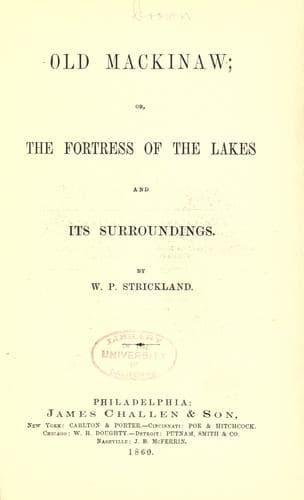
Old Mackinaw; Or, The Fortress of the Lakes and its SurroundingsStrickland, W. P. (William Peter)
History
Old Mackinaw; Or, The Fortress of the Lakes and its Surroundings
Strickland, W. P. (William Peter)
Great Lakes (North America); Mackinac Island (Mich. : Island) -- History; Michigan -- History
The physical resources of this region are of such a nature and variety
as to make Mackinaw city the entrepot of a vast commerce. This will
appear, if we consider that it is the nearest point of that extensive
district, including the entire north of the lakes inaccessible to
Chicago. When all the lines of internal communication are completed,
and the different points on the lakes settled down upon, then the
real limits of Mackinaw will drain a geographical surface of three
hundred thousand square miles; deducting the surface of the lakes from
which, there will remain two hundred and eighty thousand square miles
of country, with all the resources of agriculture and mining in the
most extraordinary degree. It will be nearly three-fold that which can
be drained by Chicago, and in point of territory, whether of quantity
or quality, Mackinaw is vastly superior, as a commercial point. With
the exception of a small portion of the mineral region, the
agricultural advantages of Michigan, Upper Wisconsin, Minnesota,
Canada West, and the Superior country, are at least equal, at the
present time, to the district shipping at Chicago, while it is more
extensive, and will have a large home market in a country affording
diversity of employment. Nothing can be more obvious, than the
superior advantages of Mackinaw, as a manufacturing point, over any
other on the lake coast.
The value of exports and imports which flow through the Straits of
Mackinaw and the Saut St. Mary was estimated a year or two since at
over _one hundred millions of dollars_. But, who can estimate a
commerce which every year increases in many fold? In 1856, there were
sent through the St. Mary Canal 11,000 tons of raw iron, 1,040 tons
of blooms, and 10,452,000 lbs. of copper; and the commercial value of
what passed through the canal amounted to upward $5,000,000. But
perhaps the most correct idea of the rapid increase of commerce in
Lake Superior may be taken from the arrivals at Superior City for the
last three years, taken from the Superior Chronicle of January, 1857.
In 1854 there were two steamboats and five sail vessels. In 1855 there
were twenty-three steamers, and ten sail vessels; and in 1856 forty
steamers and sixteen sail vessels.
We thus see that in three years the increase was seven-fold. It is
scarcely possible to imagine the limits of northwestern commerce on
the lake, when a few years shall have filled up with inhabitants the
surrounding territories.
According to the testimony of Senator Hatch, made on the floor of
Congress on the 25th of February, 1859, there were over one thousand
six hundred vessels navigating the northwestern lakes, of which the
aggregate burden was over four hundred thousand tons. They were manned
by over thirteen thousand seamen, navigating over five thousand miles
of lake and river coast, and transporting over six hundred millions of
exports and imports, being greater than the exports and imports of
the United States.
Public-domain text, read in full here on John Shaqi.
Reviews
Reviews
No reviews yet
Be the first to share your thoughts on this work.
Elsewhere in the archive
Join the Discussion
Join the discussion
Sign in to leave a comment or review.
Sign InorCreate an account