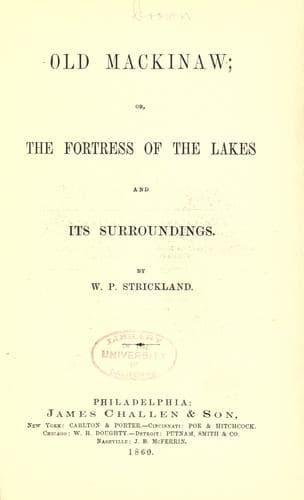
Old Mackinaw; Or, The Fortress of the Lakes and its SurroundingsStrickland, W. P. (William Peter)
History
Old Mackinaw; Or, The Fortress of the Lakes and its Surroundings
Strickland, W. P. (William Peter)
Great Lakes (North America); Mackinac Island (Mich. : Island) -- History; Michigan -- History
The State of Michigan is the greatest lumber-growing region in the
world, not only on account of its interminable forests of the choicest
pine, but in the remarkable facilities for getting it to market. With
a lake coast, on the lower peninsula alone, of over one thousand
miles--with numberless watercourses debouching at convenient distances
into her vast inland seas--she enjoys advantages which mighty empires
might envy. Her white-winged carriers are sent to almost every point
of the compass with the product of her forests, which, wherever it may
go, is the sign of improvement and progress, while by the large
expenditures involved in the manufacture, and the employment of
thousands of hardy laborers, the general prosperity is materially
enhanced, and a market opened within her own borders for a
considerable share of the surplus production of her own soil.
The annual product of the pineries alone amount to the sum of _ten and
a half millions of dollars_. The lumbering, mining, and fishing
interest combine to furnish by far the best home market in the Union,
and one which in seasons when a large surplus is not compelled to seek
a market, can boast its independence of the "bulls" and "bears" of
the great commercial metropolis. The dense forests in the interior of
the State have not yet been reached, and when the contemplated roads
are made, a field will be presented for the investment of capital of a
most remunerative character.
The government has already taken such steps as will soon make Mackinaw
the centre of a great railroad system. We need only refer to the
actual facts in order to make this clear. Congress, by an act passed
in 1855-6, granted to the State of Michigan a large body of land for
railroad purposes, designating four routes. 1. From Little Noquet Bay
to Marquette, in the Superior country. 2. From Amboy, on the
State-line of Ohio, through Lansing to or near Mackinaw. 3. From Grand
Rapids to Mackinaw. 4. From Grand Haven to Port Huron. It will be seen
that this plan is formed on the basis of a direct line from Lake
Superior through the mineral regions to Lake Michigan. The law
fortunately permitted the last two companies to make their lines at or
_near_ Traverse Bay, and as Mackinaw is but comparatively a short
distance, both companies have wisely concluded to terminate their
lines at Mackinaw. It is at once evident that the Michigan line,
centering at Mackinaw, must be met _there_, by railroads penetrating
various sections of the northern peninsula. This is evident, and we
understand is already foreseen, and measures will be adopted to
accomplish that end. In the mean time, let us examine the prospects
and influence of the two long lines of Michigan railway terminating at
Mackinaw. The whole amount of land granted to the Michigan railways is
estimated to be about 3,880,000 acres. From this, however, there will
be some deduction in consequence of lands already selected, and which
Public-domain text, read in full here on John Shaqi.
Reviews
Reviews
No reviews yet
Be the first to share your thoughts on this work.
Elsewhere in the archive
Join the Discussion
Join the discussion
Sign in to leave a comment or review.
Sign InorCreate an account