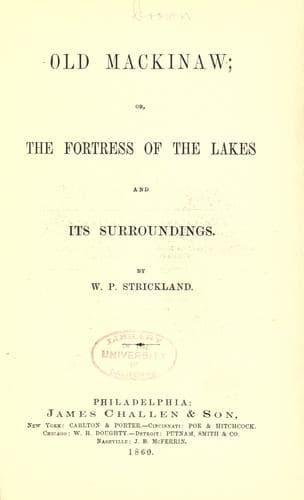
Old Mackinaw; Or, The Fortress of the Lakes and its SurroundingsStrickland, W. P. (William Peter)
History
Old Mackinaw; Or, The Fortress of the Lakes and its Surroundings
Strickland, W. P. (William Peter)
Great Lakes (North America); Mackinac Island (Mich. : Island) -- History; Michigan -- History
"Four divisions have been distinguished in the description of the
Onondaga Salt Group, though the lines of separation are by no means
well defined.
"1. Red and greenish shales below.
"2. Green and red marl, shale, and shaly limestone with some veins of
gypsum.
"3. Shaly, compact, impure limestone, with shale and marl, embracing two
ranges of plaster beds with hopper-shaped cavities between.
"4. Drab-colored, impure limestone with fibrous cavities; the
'magnesian deposit of Vanuxem.' Of these, the third is the only one
that has yielded gypsum in profitable quantities. The included masses
of gypsum, though, for the most part, even-bedded at their base, are
usually very irregular at their upper surface, often conical. The
plaster beds are supposed to be separations by molecular attraction
from the marl.
"This third division contains not only the gypseous beds, but is most
probably the source of all the salt so extensively manufactured at
Onondaga, Cayuga, and Madison; at least Vanuxem informs us that,
except in these gypseous beds, there is no evidence of salt existing
in the solid state in any of the other divisions of the Onondaga Salt
Group.
"The fourth division is remarkable for a fine columnar structure, or
needle-formed cavities, dispersed through the mass.
"In the middle counties of New York, the entire thickness of the
Onondaga Salt Group must be from six hundred to a thousand feet.
Notwithstanding its great thickness, this formation is very barren in
fossils. The corals and shells of the Niagara group suddenly ceased to
exist, perhaps, as Hall suggests, being overwhelmed by a sudden
outbreak of a buried vulcano at the bottom of the ocean, by which the
waters became surcharged not only with argillaceous sediment, but
became contaminated, either with free sulphuric acid, or sulphate of
magnesia and soda.
"The country through which the Onondaga Salt Group extends, is usually
marked by a series of low, gravelly hills, and clayey valleys, on
which a stunted growth of timber prevails, known by the name of 'Oak
Openings.' Small portions of sulphate of strontia, galena, and blende,
with rhomb spar, occur in the upper portion of the group. Gypsum and
salt are, however, the only minerals of economical value: of the
former many thousand tons are excavated. Several acidulous springs
issuing from these deposits, have been found to contain free
sulphuric acid."--_D. D. Owen's Review of the N. Y. Geological
Reports._
Jules Marcou, in his Geology of the United States, places the northern
portion of the southern peninsula of Michigan in the Terrain Devonian.
Report of J. S. Dixon and others, on Grand Traverse Bay, p. 523, in
Michigan Agricultural Reports for 1834, says:
Public-domain text, read in full here on John Shaqi.
Reviews
Reviews
No reviews yet
Be the first to share your thoughts on this work.
Elsewhere in the archive
Join the Discussion
Join the discussion
Sign in to leave a comment or review.
Sign InorCreate an account