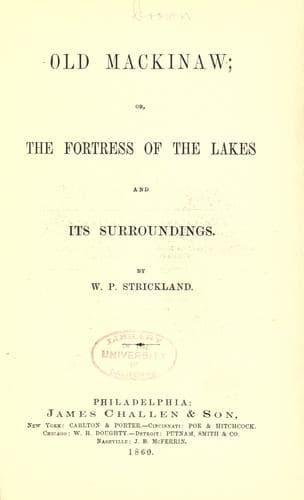
Old Mackinaw; Or, The Fortress of the Lakes and its SurroundingsStrickland, W. P. (William Peter)
History
Old Mackinaw; Or, The Fortress of the Lakes and its Surroundings
Strickland, W. P. (William Peter)
Great Lakes (North America); Mackinac Island (Mich. : Island) -- History; Michigan -- History
"The atmosphere is moist and wholesome--no disease, and healthy as any
portion of country. It is a well established fact, that water cools
first on the surface, then sinks while the warm water rises, and
consequently ice never forms till the whole body of water has been
cooled to thirty degrees. Now, from this fact, the philosopher will at
once deduce the climate of this region. Traverse Bay is from one
hundred to nine hundred feet deep and the water never cools to
thirty-two degrees till the middle of February, and in Lake Michigan
in the middle never, and so long as the water in these continuous
reservoirs is warmer than the air, the former must obviously warm the
latter.
"It is accordingly well known that in England, on the east side of the
Atlantic 7 deg. or 8 deg. farther north than Traverse Bay, the climate, as it
regards cold in winter, is about equal to that of Washington City,
and so it is on the east side of the Pacific ocean, in Oregon. Hence
it is evident that the seasons on the east side of Lake Michigan must
be uniform.
"Around Traverse Bay the frost seldom kills vegetables till in
November, and seldom occurs in spring later than the 1st of May. In
November it gets cold enough to freeze. The vapors arising from the
lake and bay fall in snow and cover the ground before the frost has
penetrated it at all; it accumulates several months till it is two
feet deep, sometimes deeper, and remains till April; and when it goes
off; cattle find enough to eat in the woods. This region is much more
sunny between the middle of March and December than southern Michigan,
and every vegetable physiologist will at once state that the influence
of this on vegetation must be very great, and accordingly spring crops
grow with such rapidity that corn is fit to be cut by the 1st of
September. From December to March, as above, the atmosphere is hazy,
cloudy, and frosty, though the thermometer never sinks so low as in
the south of Michigan by ten or twelve degrees (8 or 10 degrees below
zero, being the lowest yet known), and a winter thaw is unknown here.
Hence we never have mud in winter, and but little at any season.
"With the very defective cultivation hitherto used here, yield of
crops are as follows:--Potatoes, free of rot, 150 to 300 bushels to
the acre; oats 25 to 60; corn 25 to 50; wheat (spring) the largest yet
raised 27 bushels. Wheat raised here is much more plump than in
southern Michigan, and there is no instance of its being smothered or
injured by snow, because the snow never thaws and alternately freezes
into a hard crust, or ice, so as to exclude the air from the wheat, as
in other places.
Public-domain text, read in full here on John Shaqi.
Reviews
Reviews
No reviews yet
Be the first to share your thoughts on this work.
Elsewhere in the archive
Join the Discussion
Join the discussion
Sign in to leave a comment or review.
Sign InorCreate an account