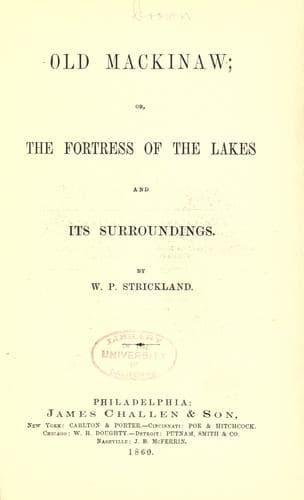
Old Mackinaw; Or, The Fortress of the Lakes and its SurroundingsStrickland, W. P. (William Peter)
History
Old Mackinaw; Or, The Fortress of the Lakes and its Surroundings
Strickland, W. P. (William Peter)
Great Lakes (North America); Mackinac Island (Mich. : Island) -- History; Michigan -- History
In order to make the trade productive of substantial benefit to all
interested in it, the West must have free course down the St.
Lawrence, and an enlargement of the Canadian canals, so that vessels
of say eighteen hundred tons can pass down to the ports of Montreal
and Quebec without unloading, and continue on their way to Europe
without breaking bulk. A depth of fourteen feet water, with locks of
corresponding capacity on the canals would accomplish this important
end. The multifarious and rapidly increasing products of the Great
West, her timber, flour, wheat, corn, oats, rye, barley, pork, beef,
butter, lard, cheese, meal, and every description of agricultural
produce could then be laid down in the ports of England so cheaply
that it would greatly reduce the cost of the necessaries of life, and
give a new impetus to the manufacturing interest of Great Britain. At
the same time it would directly tend to cheapen every article that the
West requires to import, thus proving of double advantage to our
producers. In both cases the producer and consumer would be brought
face to face, to the obvious advantage of all concerned. The
manufacturing prosperity of England depends upon an unlimited supply
of cheap labor, and that supply cannot be had unless she can supply
such laborers with an unlimited supply of cheap food. The West has the
capacity not only to furnish an inexhaustible quantity of cheap food,
but it can purchase and consume a larger amount of the productions of
English skill and labor than any other section of the world. Why,
then, cannot both parties hit on some scheme that will bring them more
closely into the fellowship of trade? It can be done, if both will
unite to obtain an unimpeded outlet via the St. Lawrence for vessels
and steamers of heavy burden. So far as Quebec and Montreal are
concerned, it is very difficult to say whether the consummation of the
proposed enlargement would redound most to their benefit, or to that
of our Western lake cities. In both cases the gain would be beyond
computation. The two important Canadian cities named would become at
once important seaports. They would become two of the depots for the
vast commerce of two continents, and would derive great benefits from
the opening up of a local traffic with the West, which at present
amounts to but very little, so far as they are concerned. Our lake
cities would all become large commercial centres, and would supply the
population of the region tributary to them, respectively, with dry
goods, crockery, hardware, paints, oils, and all kinds of imported
merchandise, at a cheaper rate by a considerable per centage, than
they could be purchased at New York, or any city on the Atlantic.
Detroit would be much nearer Liverpool than Buffalo now is by the
usual route, and Chicago and Milwaukee would be almost as near,
practically.
A few figures will show the decided advantage of water over rail as a
medium of transporting the bulky products of the West to market.
Public-domain text, read in full here on John Shaqi.
Reviews
Reviews
No reviews yet
Be the first to share your thoughts on this work.
Elsewhere in the archive
Join the Discussion
Join the discussion
Sign in to leave a comment or review.
Sign InorCreate an account