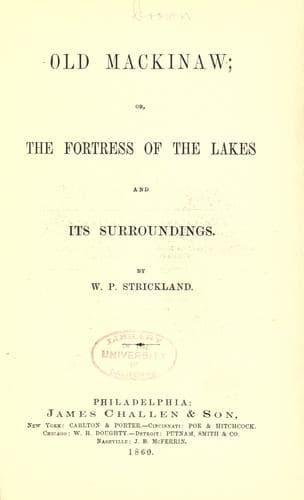
Old Mackinaw; Or, The Fortress of the Lakes and its SurroundingsStrickland, W. P. (William Peter)
History
Old Mackinaw; Or, The Fortress of the Lakes and its Surroundings
Strickland, W. P. (William Peter)
Great Lakes (North America); Mackinac Island (Mich. : Island) -- History; Michigan -- History
It has already been shown that a ton of any kind of freight cannot be
laid down at Portland from Detroit, by rail, under $8.80, without a
loss to the stockholders, nor to Boston under $9.65, except with the
same result; nor at New York _via_ the Great Western, New York
Central, and Hudson River roads under $6.82, without actual loss to
those roads, so that the case would stand thus:--Detroit to Portland,
per ton, _via_ G. T. R., $8.80; Detroit to Boston, do. do., $9.85;
Detroit to New York, $6.82. Add $4.00 per ton for ocean freights, and
we have in each case respectively, $12.80, $13.85, and $10.82 per ton
to Liverpool.
Now we maintain that a screw steamer of 1800 tons burden, costing,
when completed, $150,000, can carry much cheaper than a road like the
Grand Trunk, costing $60,000,000, or the New York Central and its
connections. A steamer of that capacity would carry 1,500 tons of
freight; 600 tons of coal would run her across the Atlantic, and she
could coal from Chicago or Detroit to Newfoundland, and from the
latter point to Liverpool. By doing this, she could carry 300 tons
more freight than if she coaled for the entire voyage from Chicago to
Liverpool. All the principal exports and imports of Michigan, Indiana,
Western Ohio, Kentucky, &c., would find their way to Detroit, and this
point would of necessity become the great centre of the direct trade
between Europe and the States above mentioned.
Two steamers per week could be run with profit on the route during the
season of navigation; each steamer would make two round trips and a
half per season of seven months' navigation, allowing two months for
each round trip. At this rate sixteen ocean steamers would be required
to make up a semi-weekly line, and were the Canadian canals enlarged
and ready for use by the middle of next April, there would be at once
sufficient trade to sustain them, at much cheaper rates for freight
and passage than is now charged by any route or combination of routes
in existence, as the following will show conclusively:
Each round trip would give the following sums for freight and
passage:--1500 tons of freight at $6 per ton, $9,000; 40 cabin
passengers at $50 each, $2,000; 50 steerage do. do. $25 each, $1,250.
Total for the trip out, $12,250. Inward bound:--600 tons freight at
$6, $3,600; 75 cabin passengers at $60, $4,500; 300 steerage do. do.,
$30, $9,000--$17,100. Add outward receipts, $12,250. Total, $29,350.
The total cost of the trip, including insurance, would not exceed
$14,000. Total net profits, $15,250.
Public-domain text, read in full here on John Shaqi.
Reviews
Reviews
No reviews yet
Be the first to share your thoughts on this work.
Elsewhere in the archive
Join the Discussion
Join the discussion
Sign in to leave a comment or review.
Sign InorCreate an account