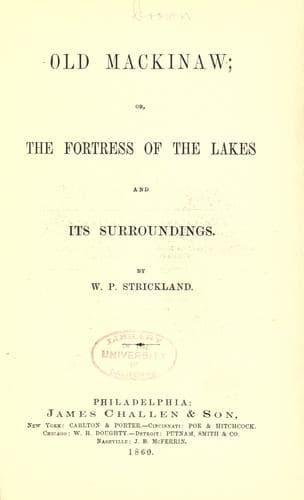
Old Mackinaw; Or, The Fortress of the Lakes and its SurroundingsStrickland, W. P. (William Peter)
History
Old Mackinaw; Or, The Fortress of the Lakes and its Surroundings
Strickland, W. P. (William Peter)
Great Lakes (North America); Mackinac Island (Mich. : Island) -- History; Michigan -- History
On the southern shore, beyond White Fish Point, immense sand hills can
be seen rising from four hundred to one thousand feet in height. After
passing Pictured Rocks, which we have elsewhere described, the steamer
approaches Grand Island, the shores of which present a magnificent
appearance. This island is about one hundred twenty-five miles from
the Saut and is about ten miles long and five wide. It is wild and
romantic. The cliffs of sandstone broken into by the waves form
picturesque caverns, pillars, and arches of great dimensions.
Forty-five miles further is the town of Marquette one of the most
flourishing places on the borders of the lake, and the entrepot of the
vast mineral wealth in that region. Near this place are the Carp and
Dead rivers, both which have rapids and falls of great beauty. Sailing
in a northwestern direction the steamer passes Standards Rock, a
solitary and dangerous projection, rising out of the lake at the
entrance of Keweenaw Bay. At the head of this bay stands the harbor
of L'Anse a short distance from which are located a Roman Catholic and
Methodist mission house and church, both of which, on each sides of
the bay where they are located, are surrounded by Indian tribes and
settlements.
Passing along, the steamer enters Portage Lake an extensive and
beautiful sheet of water extending nearly the entire breadth of the
peninsula of Keweenaw Point, which is a large extent of land jutting
out into Lake Superior, from ten to twenty miles wide and sixty in
length. This whole section abounds in silver and copper ores. After
passing Manitou Island, Copper Harbor, one of the best on the lake is
reached. At this place there is a flourishing village. The next points
are Agate Harbor, Eagle Harbor, and Eagle River Harbor. It was at this
point that the lamented Dr. Houghton was drowned in October 1845. He
was the State Geologist of Michigan, and while coming down from a
portage to Copper Harbor, with his four Indian companions _du voyage_,
the boat was swamped in a storm about a mile and a half from Eagle
River. Two of the _voyageurs_ were saved by being thrown by the waves
upon the rocks ten feet above the usual level of the waters.
Public-domain text, read in full here on John Shaqi.
Reviews
Reviews
No reviews yet
Be the first to share your thoughts on this work.
Elsewhere in the archive
Join the Discussion
Join the discussion
Sign in to leave a comment or review.
Sign InorCreate an account