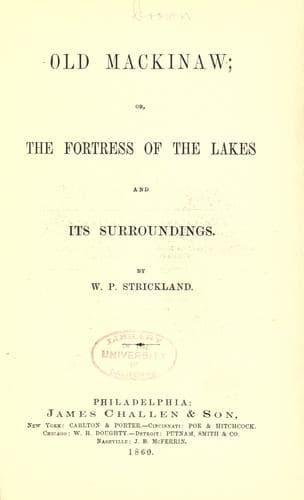
Old Mackinaw; Or, The Fortress of the Lakes and its SurroundingsStrickland, W. P. (William Peter)
History
Old Mackinaw; Or, The Fortress of the Lakes and its Surroundings
Strickland, W. P. (William Peter)
Great Lakes (North America); Mackinac Island (Mich. : Island) -- History; Michigan -- History
"In order to aid the execution of the design, signified to us by many
of the savages, of taking up their abode at this point, where some
have already passed the winter, hunting in the neighborhood, we
ourselves have also wintered here, in order to make arrangements for
establishing the mission of _St. Ignace_, from whence it will be easy
to have access to all the Indians of Lake Huron, when the several
tribes shall have settled each on its own lands.
"With these advantages, the place has also its inconveniences,
particularly for the French, who are not yet familiar, as are the
savages, with the different kinds of fishery, in which the latter are
trained from their birth; the winds and the tides occasion no small
embarrassment to the fishermen.
"The winds: For this is the central point between the three great
lakes which surround it, and which seem incessantly tossing ball at
each other. For no sooner has the wind ceased blowing from Lake
Michigan than Lake Huron hurls back the gale it has received, and
Lake Superior in its turn, sends forth its blasts from another
quarter, and thus the game is played from one to the other--and as
these lakes are of vast extent, the winds cannot be otherwise than
boisterous, especially during the autumn."
"Old Mackinaw," the Indian name of which is Pe-quod-e-non-ge, an
Indian town on the south side of the Straits, became the place of the
first French settlement northwest of Fort Frontenac, or Cadaraeque on
Lake Ontario. The settlement was made by father Marquette, in 1671.
Pe-quod-e-non-ge, as we have seen in a previous Chapter, with its
coasts and islands before it, has been the theatre of some of the most
exciting and interesting events in Indian history, previous to the
arrival of the "white man." It was the Metropolis of a portion of the
Ojibwa, and Ottawa nations. It was there that their Congresses met, to
adopt a policy which terminated in the conquest of the country south
of it--it was there that the tramping feet of thousands of plumed and
painted warriors shook Pe-quod-e-non-ge, while dancing their war
dances--it was from there that the startling sound of the war yell of
these thousands was wafted to the adjacent coast and islands, making
the peaceful welkin ring with their unearthly shouts of victory or
death. In process of time a Chapel and Fort were erected, and it
became a strong-hold and trading post of the greatest importance to
the entire region of the northwest, being the gateway of commerce
between the St. Lawrence and the Mississippi, and also the grand
avenue to the Upper Lakes of the north, and the rendezvous of the
traders, merchants, trappers, soldiers, missionaries and Indians of
the whole northwest. Villages of Hurons and Ottawas were located in
the vicinity of the Fort and Chapel. The Fort inclosed an area of
about several acres, and was surrounded with cedar pickets. The
remains of the fort and buildings can still be seen. On an eminence
Public-domain text, read in full here on John Shaqi.
Reviews
Reviews
No reviews yet
Be the first to share your thoughts on this work.
Join the Discussion
Join the discussion
Sign in to leave a comment or review.
Sign InorCreate an account