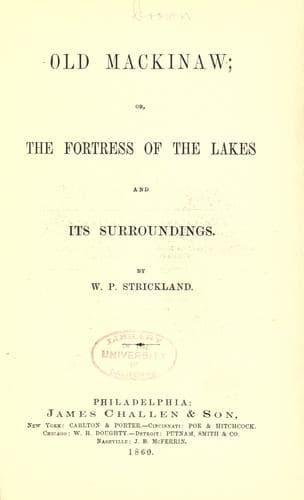
Old Mackinaw; Or, The Fortress of the Lakes and its SurroundingsStrickland, W. P. (William Peter)
History
Old Mackinaw; Or, The Fortress of the Lakes and its Surroundings
Strickland, W. P. (William Peter)
Great Lakes (North America); Mackinac Island (Mich. : Island) -- History; Michigan -- History
It is an established fact, that Marquette organized the Mission at Old
Mackinaw, in the year 1671, subsequently to that at the opposite
point, and that he remained there until the year 1673, when he
embarked with Joliet on his exploring tour of the Mississippi.
Charlevoix places the Mission of St. Ignace, on the south side of the
Straits, adjoining the Fort, and has made no such designation on the
north side, showing at least that this mission was more modern than
the other. Nearly all the Jesuit Missions bore the name of St.
Ignatius, in honor of their founder, as those of the Franciscans bore
the name of St. Francis. Ignatius Loyola and Francis Xavier were the
founders of these sects.
CHAPTER IV.
La Salle's visit to Mackinaw -- English traders -- La
Hontan's visit -- Mackinaw an English fort -- Speech of a
Chippewa Chief -- Indian stratagem -- Massacre of the English
at the fort -- Escape of Mr. Alexander Henry -- Early white
settlement of Mackinaw -- Present description -- Relations of
the Jesuits -- Remarkable phenomena -- Parhelia --
Subterranean river.
In the summer of 1679 the Griffin, built by La Salle and his company
on the shore of Lake Erie, at the present site of the town of Erie,
passed up the St. Clair, sailed over the Huron, and entering the
Straits, found a safe harbor at Old Mackinaw. La Salle's expedition
passed eight or nine years at this place, and from hence they
penetrated the country in all directions. At the same time it
continued to be the summer resort of numerous Indian tribes who came
here to trade and engage in the wild sports and recreations peculiar
to the savage race. As a city of peace, it was regarded in the same
light that the ancient Hebrews regarded their cities of Refuge, and
among those who congregated here all animosities were forgotten. The
smoke of the calumet of peace always ascended, and the war cry never
as yet has been heard in its streets.
In Heriot's Travels, published in 1807, we find the following
interesting item:
'In 1671 Father Marquette came hither with a party of Hurons, whom he
prevailed on to form a settlement. A fort was constructed, and it
afterward became an important spot. It was the place of general
assemblage for all the French who went to traffic with the distant
nations. It was the asylum of all savages who came to exchange their
furs for merchandise. When individuals belonging to tribes at war with
each other came thither, and met on commercial adventure, their
animosities were suspended.'
Public-domain text, read in full here on John Shaqi.
Reviews
Reviews
No reviews yet
Be the first to share your thoughts on this work.
Join the Discussion
Join the discussion
Sign in to leave a comment or review.
Sign InorCreate an account