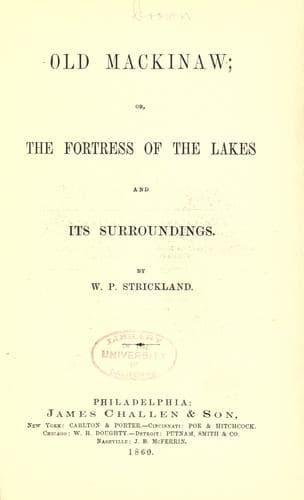
Old Mackinaw; Or, The Fortress of the Lakes and its SurroundingsStrickland, W. P. (William Peter)
History
Old Mackinaw; Or, The Fortress of the Lakes and its Surroundings
Strickland, W. P. (William Peter)
Great Lakes (North America); Mackinac Island (Mich. : Island) -- History; Michigan -- History
every hue stroll restlessly about the place. Such was old fort
Mackinaw in 1763."
La Hontan, who visited Mackinaw in 1688, says: "It is a place of great
importance. It is not above half a league distant from the Illinese
(Michigan) Lake. Here the Hurons and Ottawas have each of them a
village, the one being severed from the other by a single palisade,
but the Ottawas are beginning to build a fort upon a hill that stands
but one thousand or twelve hundred paces off. In this place the
Jesuits have a little house or college adjoining to a church, and
inclosed with pales that separate it from the village of the Hurons.
The Courriers de Bois have but a very small settlement here, at the
same time it is not inconsiderable, as being the staple of all the
goods that they truck with the south and west savages; for they cannot
avoid passing this way when they go to the seats of the Illinese and
the Oumamis on to the Bay des Puanto, and to the River Mississippi.
Missilimackinac is situated very advantageously, for the Iroquese dare
not venture with their sorry canoes to cross the stright of the
Illinese Lake, which is two leagues over; besides that the Lake of the
Hurons is too rough for such slender boats, and as they cannot come to
it by water, so they cannot approach it by land by reason of the
marshes, fens, and little rivers which it would be very difficult to
cross, not to mention that the stright of the Illinese Lake lies still
in their way."
As rivals of the French, the English were never regarded with favor by
the various Indian tribes. Constant encroachments by the English from
year to year, though they were lavish of their gifts did not tend to
soften the hostility of the tribes. Thus matters continued until
Mackinaw passed into the hands of the English, which event took place
after the fall of Quebec in the year 1759. This transfer of
jurisdiction from a people that the Indians loved to one that they
experienced a growing hate for during three-quarters of a century,
filled them with a spirit of revenge. Such was the dislike of the
Indians of Mackinaw to the English, that when Alexander Henry visited
that place in 1761, he was obliged to conceal the fact that he was an
Englishman and disguise himself as a Canadian voyager. On the way he
was frequently warned by the Indians to turn back, as he would not be
received at Mackinaw, and as there were no British soldiers there as
yet, he was assured that his visit would be attend with great hazard.
He still persisted, however, and finally, with his canoes laden with
goods he reached the fort, which, we have before remarked, was
surrounded with palisades, and occupied the high ground immediately
back from the beach. When he entered the village he met with a cold
reception, and the inhabitants did all in their power to alarm and
discourage him.
Public-domain text, read in full here on John Shaqi.
Reviews
Reviews
No reviews yet
Be the first to share your thoughts on this work.
Join the Discussion
Join the discussion
Sign in to leave a comment or review.
Sign InorCreate an account