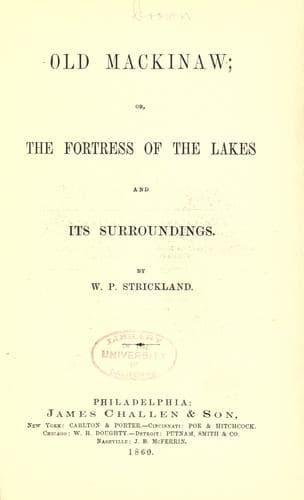
Old Mackinaw; Or, The Fortress of the Lakes and its SurroundingsStrickland, W. P. (William Peter)
History
Old Mackinaw; Or, The Fortress of the Lakes and its Surroundings
Strickland, W. P. (William Peter)
Great Lakes (North America); Mackinac Island (Mich. : Island) -- History; Michigan -- History
The old fort having been deserted by the English, as we have noticed
in a previous chapter, and they having fled to the Island of Mackinaw,
which, in the Indian name, signifies Island of the giant fairies,
preparations were made for a settlement. Sir Wm. Johnston called a
grand council with those Indians who had been engaged in the massacre
at Old Mackinaw. By this council, which was held in 1764, the spring
following the siege, a way was opened for St. Clair to negotiate for
the island, and also for the grants previously made by the Indians to
the French for military purposes. The first thing done after the
island had been obtained was the erection of a government house. The
French and others who still remained at Old Mackinaw, amounting only
to about three hundred, continued a few years, when they finally left,
and everything was suffered to go into decay. A desolation reigned
over it for many years, and, on account of the bloody siege, that
point, which was the most attractive as well as the most important to
Indians, French, and English in all the Lake region was, as if by
common consent, abandoned.
[Illustration: Arch Rock.]
[Illustration: Rock Castle--Pictured Rocks.]
The "New Mackinaw," as it is called, distant seven miles from the Old,
is on an island about nine miles in circumference, and covers an area
of six thousand acres. Its extreme elevation above the lake is about
three hundred and twelve feet. The village and fortress are situated
on the southeastern extremity of the island, where there is a good
harbor protected by a water battery. The island remained in possession
of the British until 1793, when it was surrendered to the United
States. It was retaken in 1812, but restored again by the treaty of
Ghent, in 1814. It is situated in North lat. 45 deg. 54', West lon. 84 deg.
30' from Greenwich, being 7 deg. 30' west from Washington. It is three
hundred and fifty miles north of Chicago and about three hundred miles
north from Detroit, and about two hundred and fifty miles west of
Collingswood, Canada. The fort stands on an elevated ground about two
hundred feet above the water. The town contains at present three
hotels, six boarding houses, eight dry-goods stores, and seven
groceries. Its public buildings are a Court House, Jail, Custom House,
Post Office, and Express Office. There are two Churches, the Roman
Catholic and Presbyterian.
Public-domain text, read in full here on John Shaqi.
Reviews
Reviews
No reviews yet
Be the first to share your thoughts on this work.
Join the Discussion
Join the discussion
Sign in to leave a comment or review.
Sign InorCreate an account