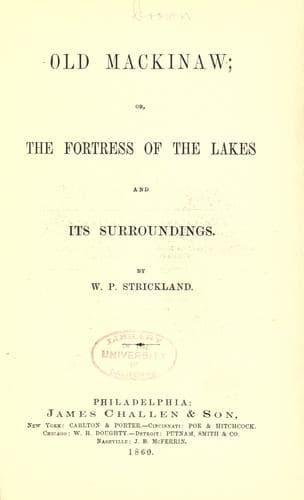
Old Mackinaw; Or, The Fortress of the Lakes and its SurroundingsStrickland, W. P. (William Peter)
History
Old Mackinaw; Or, The Fortress of the Lakes and its Surroundings
Strickland, W. P. (William Peter)
Great Lakes (North America); Mackinac Island (Mich. : Island) -- History; Michigan -- History
"At dawn the citizens of the village were roused, and told to flee to
a place called the Distillery, west of the present village, as the
English troops were about to attack the American fort, and that the
English commanding officer had pledged his word for the safety of the
lives of those citizens who would flee to the place designated. This
was the first intimation the citizens had of war being declared
between the United States and Great Britain. Soon a cannon shot was
fired over the fort, its booming being also the first intimation the
American garrison had of the country being in a state of war. An
English officer appeared with a flag to summon the garrison to
surrender, stating the overwhelming force they had in command. The
American garrison, being short of one full company of men, was
surrendered, and the few troops taken and sent to Detroit on parole.
After this the English built and occupied Fort George, (now called
Fort Holmes) between the years 1812 and 1814. The English government
paid ten thousand pounds as prize-money to the volunteers and
soldiers, and merchandise and arms to the Indians. In the year 1836 I
examined the list or pay-roll for this prize-money; the names of all
those who participated in the taking of Fort Mackinac were there
enrolled, the money was divided according to rank, and each person
receipted for his individual share.
"It is worth knowing, that by the treaty of Paris, of 1783,
acknowledging the independence of the United States, and fixing its
boundaries, Fort Mackinac fell under the jurisdiction of the United
States, and was surrendered, according to McKenzie, in 1794. In 1812
it was taken, as before stated, by the English and their Indian
allies. It resisted an attack from a strong detachment of the American
army and navy in 1814, under Col. Croghan, and was finally restored to
the United States by the treaty of Ghent.
"In 1814 Col. Croghan landed at the English Landing, under cover of
the guns of the American vessels. The troops moved from the landing,
and had reached Mr. M. Dousman's farm-house. The skirmishing with
the English and Indians had already commenced. East from the house is
a ridge over which the road lay. On this ridge and back of it, also on
each side of the road, the English were posted in force. The gallant
Major Holmes, on reaching the clearing near the house, formed his men
for a charge upon the enemy posted on the ridge. To encourage his
troops he led the charge. The English and Indians, seeing the strong
force, had commenced retreating, when an English sergeant thought he
might as well discharge the cannon before retreating with his
comrades, so accordingly applied the match. At this instant, Major
Holmes was either killed by a grape shot, or by an accidental musket
ball. His death threw the Americans into a panic, and they immediately
commenced a retreat, which ended in confusion.
Public-domain text, read in full here on John Shaqi.
Reviews
Reviews
No reviews yet
Be the first to share your thoughts on this work.
Join the Discussion
Join the discussion
Sign in to leave a comment or review.
Sign InorCreate an account