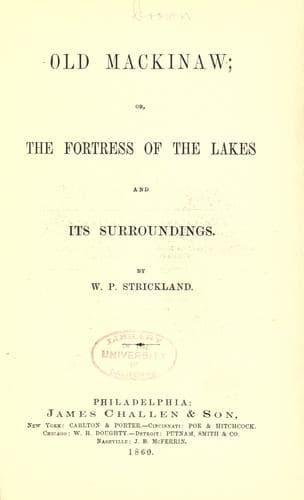
Old Mackinaw; Or, The Fortress of the Lakes and its SurroundingsStrickland, W. P. (William Peter)
History
Old Mackinaw; Or, The Fortress of the Lakes and its Surroundings
Strickland, W. P. (William Peter)
Great Lakes (North America); Mackinac Island (Mich. : Island) -- History; Michigan -- History
The natural scenery of Michigan is imposing. The extensive tracts of
dense forests, clothed with the richest verdure, fresh as when it
first came from the hands of the Creator; the prairies and lakes which
abound, the wide parks, whose soil is entirely covered for miles with
large and rich flowers, present a striking and agreeable contrast. The
beech and black walnut, the elm, the maple, the hickory, and the oaks
of different species and large size, the lind and the bass-wood, and
various other kinds of forest trees, plainly indicate the fertility of
the soil from whence they spring. Grape vines often hang from the
branches a foot in circumference, clustering around their trunks, or
thickening the undergrowth along the banks of rivers; and, while the
glades open to the sun like cultivated grounds, the more
thickly-timbered forests, shut out from the sky by the mass of
vegetation, present in summer a gloomy twilight.
In traveling along the main roads of Michigan, splendid tracts of
park-like lawns sweep along the path for miles covered with flowers,
broken by prairies, thick forests, and lakes.
Fort Gratiot stands at the foot of Lake Huron and commands the
entrance to the upper lakes. Advancing along the western shore of this
lake the voyager sees a long, alluvial bank covered with a forest of
pine, poplar, beech, and hemlock.
On advancing further the banks become more elevated until they rise to
forty feet in height. About fifty miles from Fort Gratiot, a large
rock rises to the surface of the lake, a mile or so from the shore,
which is called the "White Rock." From the earliest period this rock
has been regarded as an altar or a landmark. It was to the early
voyagers a beacon to guide them in their course; but to the Indians it
was a place of oblation, where they offered sacrifices to the spirits
of the lakes.
Saginaw Bay is a large indentation of the shoreline like to that of
Green Bay in Lake Michigan, but not so large. Near its centre are a
number of small islands. Twenty miles from its mouth stands the
thriving town of Saginaw. From the northwesterly cape of Saginaw Bay
to Flat Rock Point, the shore of Lake Huron presents a bank of
alluvial soil, with a margin of sand along its border intersected with
frequent masses of limestone rock, in some places ground to fragments
by the surging of the waves.
Thunder Bay is also another indentation made by the Lake. It was thus
called from the impression that at this point the air was more than
ordinarily charged with electricity.
Bois Blanc Island, at the head of Lake Huron, stretches in the form of
a crescent between the Island of Mackinac and the lower peninsula of
Michigan. It is from ten to twelve miles in length by three or four in
breadth. The lower part of this island is sandy, but the larger
portion of it is covered with a fertile soil bearing a forest of elm,
maple, oak, ash, whitewood and beech. It has been surveyed and a
government light-house stands on its eastern point.
Public-domain text, read in full here on John Shaqi.
Reviews
Reviews
No reviews yet
Be the first to share your thoughts on this work.
Elsewhere in the archive
Join the Discussion
Join the discussion
Sign in to leave a comment or review.
Sign InorCreate an account