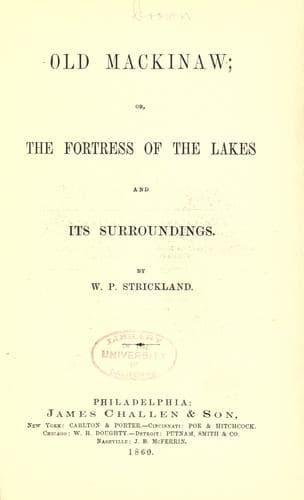
Old Mackinaw; Or, The Fortress of the Lakes and its SurroundingsStrickland, W. P. (William Peter)
History
Old Mackinaw; Or, The Fortress of the Lakes and its Surroundings
Strickland, W. P. (William Peter)
Great Lakes (North America); Mackinac Island (Mich. : Island) -- History; Michigan -- History
"This religious community, is the Third Order of St. Francis, of
Assisi, instituted in Europe by this saint in 1221. It was established
for persons married or single living in the world, united by certain
pious exercises, compatible with a secular state. It soon spread over
all Europe, and even kings and queens on their thrones vied with the
poorest peasants in eagerly entering this order, to share the labors
of the mission within its sphere, and to participate in its spiritual
benefits. Among the persons of this order, who were expelled from
their cloister homes during the revolution which agitated Europe in
1848, was Sister Teresa Hackelmayer. This nun, at the proposal of a
missionary father in America, and by permission of her Superior, came
to New York in the winter of 1851, to establish a community of her
order in that State. But meeting with disappointment there, she
finally established a convent at Oldenburg, in the State of Indiana.
In 1851, a second convent of this order was founded at Nojoshing, four
miles from Milwaukee, on Lake Michigan. In 1853, the Rev. J. B.
Weikamp founded, in West Chicago, the third convent of this order, and
also formed a community of Brothers;--and in October 1855, with the
understanding of Bishop Baraga, then Vicar Apostolic of Upper
Michigan, he transferred those two communities to 'Cross Village'--his
present location.
"The company having ranged through the building, as observed, took a
walk outside. From the south side of the convent, a broad walk is laid
out reaching to an inclosure of some forty feet square, at the
distance of about fifteen rods. Another and narrower walk through the
centre of this inclosure leads to a small square building, on the
opposite side, having a four-sided roof meeting in a point, and
surmounted by a cross. On entering this building, a lounge or settee,
stands in front, and on the wall above it, hangs a piece of board or
canvass, painted black, on which are human skulls of different sizes,
each with two cross bones painted in white. A trap-door is raised from
the floor, and a deep, spacious vault is opened to view: this is the
place of burial for the Superior of the convent. On the outside, the
spaces on either side of the little walk are intended to be the last
resting-places of the brothers and sisters. It is a solemn thought to
see men thus prepare deliberately for _Death!_ But as the party
retraced their steps in such cheerful, good humor, loitering toward
the convent, one might have supposed that the beautiful weather, the
bright sunshine, and the bracing air had, for the time, scattered away
all thoughts of death. Among the questions proposed to the Superior
was, 'Whether at any time the brothers and sisters were allowed to
have social, familiar intercourse with each other?' The Superior
answered, in substance, that they were not; nor even allowed to speak
to each other, without permission of the Superior. 'Then according to
Public-domain text, read in full here on John Shaqi.
Reviews
Reviews
No reviews yet
Be the first to share your thoughts on this work.
Elsewhere in the archive
Join the Discussion
Join the discussion
Sign in to leave a comment or review.
Sign InorCreate an account