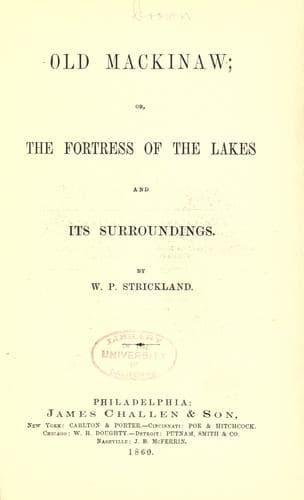
Old Mackinaw; Or, The Fortress of the Lakes and its SurroundingsStrickland, W. P. (William Peter)
History
Old Mackinaw; Or, The Fortress of the Lakes and its Surroundings
Strickland, W. P. (William Peter)
Great Lakes (North America); Mackinac Island (Mich. : Island) -- History; Michigan -- History
your principle,' some one rejoined, 'the world would soon come to an
end!' The remark raised a general laugh, in which the Superior himself
joined heartily."
CHAPTER VIII.
Three epochs -- The romantic -- The military -- The
agricultural and commercial -- An inviting region -- Jesuit
and Protestant missions -- First Protestant mission -- First
missionary -- Islands of Mackinac and Green Bay -- La Pointe
-- Saut St. Mary -- Presbyterians -- Baptists -- Methodists
-- Revival at Fort Brady -- Ke-wee-naw -- Fon du Lac --
Shawnees -- Pottawatimies -- Eagle River -- Ontonagon -- Camp
River -- Iroquois Point -- Saginaw Indians -- Melancholy
reflections -- Number of Indians in the States and
Territories.
The history of this region, in the language of one, exhibits three
distinct and strongly marked epochs. The first may be properly
denominated the romantic, which extends to the year 1760, when its
dominion passed from the hands of the French to the English. This was
the period when the first beams of civilization had scarcely
penetrated its forests, and the paddles of the French fur trader swept
the lakes, and the boat songs of the _voyageurs_ awakened the tribes
on their wild and romantic shores.
The second epoch is the military, which commenced with the Pontiac
war, running down through the successive struggles of the British, the
Indians, and the Americans, to obtain dominion of the country, and
ending with the victory of Commodore Perry, the defeat of Proctor, the
victory of General Harrison and the death of Tecumseh, the leader of
the Anglo-savage conspiracy on the banks of the Thames.
The third may be denominated the enterprising, the hardy, the
mechanical, and working period, commencing with the opening of the
country to emigrant settlers, the age of agriculture, commerce, and
manufactures, of harbors, cities, canals, and railroads, when the
landscapes of the forest were meted out by the compass and chain of
the surveyor, when its lakes and rivers were sounded, and their
capacity, to turn the wheel of a mill or to float a ship, were
demonstrated, thus opening up avenues of commerce and industry. Its
wild and savage character has passed away, and given place to
civilization, religion, and commerce, inviting the denizens of
over-crowded cities to its broad lakes and beautiful rivers, its rich
mines and fertile prairies, and promising a rapid and abundant
remuneration for toil.
Public-domain text, read in full here on John Shaqi.
Reviews
Reviews
No reviews yet
Be the first to share your thoughts on this work.
Elsewhere in the archive
Join the Discussion
Join the discussion
Sign in to leave a comment or review.
Sign InorCreate an account