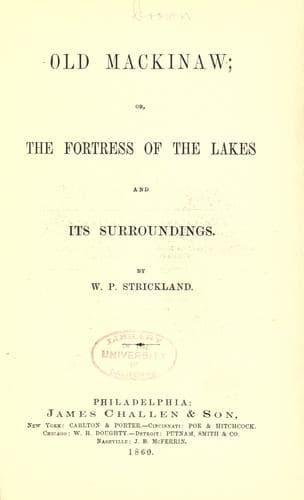
Old Mackinaw; Or, The Fortress of the Lakes and its SurroundingsStrickland, W. P. (William Peter)
History
Old Mackinaw; Or, The Fortress of the Lakes and its Surroundings
Strickland, W. P. (William Peter)
Great Lakes (North America); Mackinac Island (Mich. : Island) -- History; Michigan -- History
We have alluded to the labors and sacrifices of the Jesuit
missionaries in the early period of the history of the northwest, and
it is right and proper that the labors of the Protestant missionaries,
though of a much later period, should not be forgotten. The Jesuit
fathers were not alone in sacrifice and toil in introducing the Gospel
among the tribes of the northwest. The first Protestant missions
established in this region, as far as we have been able to learn, were
those of the Presbyterian Church on the Island of Mackinac and at
Green Bay.
The first missionary who visited Mackinaw was the Rev. David Bacon,
father of the Rev. Leonard Bacon, D. D., of New Haven. He was sent out
by the Connecticut Missionary Society in 1800, and commenced his
mission in Detroit, where, after remaining a year or two, he
relinquished his field to a Moravian missionary, Rev. Mr. Denky, and
visited the Indians on the Maumee. From this he returned to Detroit,
and from thence went to Mackinac, where he remained until the
missionary society was compelled, from want of funds, to recall their
missionary.
The following interesting account was given by C. J. Walker, Esq.,
before the Historical Society of Detroit:
"The Connecticut Missionary Society is, I believe, the oldest
Missionary Association in America. It was organized in June, 1795,
the General Association of Connecticut, at its annual meeting that
year, having organized itself into a society of that name. Its object
was 'to Christianize the heathen in North America, and to support and
promote Christian knowledge in the new settlements within the United
States.' For some years its efforts were principally directed to
sending missionaries 'to the new settlements in Vermont, New York, and
Pennsylvania,' and subsequently 'New Connecticut,' or the Western
Reserve of Ohio, became an important field of its operations. The
trustees, in June, 1800, determined 'that a discreet man, animated by
the love of God and souls, of a good common education, be sought for,
to travel among the Indian tribes south and west of Lake Erie, to
explore their situation and learn their feelings with respect to
Christianity, and so far as he has opportunity to teach them its
doctrines and duties.' A very sensible letter of 'Instructions' was
adopted and a long message 'to the Indian tribes bordering on Lake
Erie' prepared, showing very little knowledge of Indian mind and
character. Mr. David Bacon presented himself as a candidate for this
somewhat unpromising field of labor. His son says he was one of those
men who are called visionary and enthusiasts by men of more prosaic
and plodding temperament. He had not a liberal education, but was a
man of eminent intellectual powers and of intensely thoughtful habits,
and beside a deep religious experience, he had endeavored diligently
to fit himself for a missionary life, the self-denying labors of which
he ardently coveted. On examination Mr. Bacon was accepted.
Public-domain text, read in full here on John Shaqi.
Reviews
Reviews
No reviews yet
Be the first to share your thoughts on this work.
Elsewhere in the archive
Join the Discussion
Join the discussion
Sign in to leave a comment or review.
Sign InorCreate an account