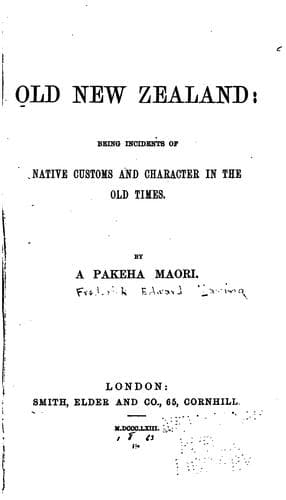
Old New Zealand: Being Incidents of Native Customs and Character in the Old Times — John Shaqi
Old New Zealand: Being Incidents of Native Customs and Character in the Old TimesManing, Frederick Edward
History
Old New Zealand: Being Incidents of Native Customs and Character in the Old Times
Maning, Frederick Edward
Māori (New Zealand people); New Zealand -- Description and travel
Here I must remark that in those days the value of a pakeha to a tribe
was enormous. For want of pakehas to trade with, and from whom to
procure gunpowder and muskets, many tribes or sections of tribes were
about this time exterminated, or nearly so, by their more fortunate
neighbours who got pakehas before them, and who consequently became
armed with muskets first. A pakeha trader was therefore of a value say
about twenty times his own weight in muskets. This, according to my
notes made at the time, I find to have represented a value in New
Zealand something about what we mean in England when we talk of the sum
total of the national debt. A book-keeper, or a second-rate pakeha, not
a trader, might be valued at, say, his weight in tomahawks; an enormous
sum also. The poorest labouring pakeha, though he might have no
property, would earn something--his value to the chief and tribe with
whom he lived might be estimated at, say, his weight in fish-hooks, or
about a hundred thousand pounds or so: value estimated by eagerness to
obtain the article.
The value of a musket was not to be estimated to a native by just what
he gave for it: he gave all he had, or could procure, and had he ten
times as much to give, he would have given it, if necessary; or if not,
he would buy ten muskets instead of one. Muskets! muskets! muskets!
nothing but muskets, was the first demand of the Maori: muskets and
gunpowder, at any cost.
I do not, however, mean to affirm that pakehas were at this time valued
"as such,"--like Mr. Pickwick's silk stockings, which were very good
and valuable stockings, "as stockings;" not at all. A loose straggling
pakeha--a runaway from a ship for instance, who had nothing, and was
never likely to have anything--a vagrant straggler passing from place
to place,--was not of much account, even in those times. Two men of
this description (runaway sailors) were hospitably entertained one
night by a chief, a very particular friend of mine, who, to pay himself
for his trouble and outlay, ate one of them next morning.
Remember, my good reader, I don't deal in fiction; my friend ate the
pakeha sure enough, and killed him before he ate him: which was civil,
for it was not always done. But then, certainly, the pakeha was a
_tutua_, a nobody, a fellow not worth a spike-nail; no one knew him; he
had no relations, no goods, no expectations, no anything: what could be
made of him? Of what use on earth was he except to eat? And, indeed,
not much good even for that--they say he was not good meat. But good
well-to-do pakehas, traders, ship-captains, labourers, or employers of
labour, these were to be honoured, cherished, caressed, protected--and
plucked: plucked judiciously (the Maori is a clever fellow in his way),
so that the feathers might grow again. But as for poor, mean, mere
_Pakeha tutua, e aha te pai_?
Public-domain text, read in full here on John Shaqi.
Reviews
Reviews
No reviews yet
Be the first to share your thoughts on this work.
Join the Discussion
Join the discussion
Sign in to leave a comment or review.
Sign InorCreate an account