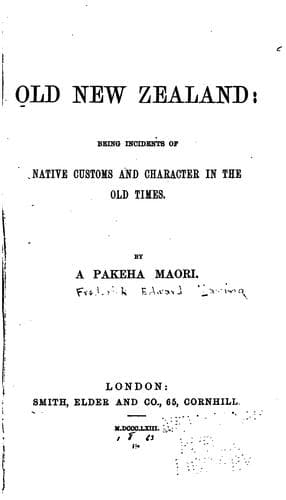
Old New Zealand: Being Incidents of Native Customs and Character in the Old TimesManing, Frederick Edward
History
Old New Zealand: Being Incidents of Native Customs and Character in the Old Times
Maning, Frederick Edward
Māori (New Zealand people); New Zealand -- Description and travel
Talk to me of the "native difficulty"--pooh! I think it was in 1822
that an old friend of mine bought, at Kawhia, a woman who was just
going to be baked. He gave a cartridge-box full of cartridges for her;
which was a great deal more than she was really worth: but humanity
does not stick at trifles. He took her back to her friends at Taranaki,
whence she had been taken, and her friends there gave him at once two
tons of flax and eighteen pigs, and asked him to remain a few days
longer till they should collect a still larger present in return for
his kindness; but, as he found out their intention was to take the
schooner, and knock himself and crew on the head, he made off in the
night. Yet he maintains, to this day, that "virtue is its own reward:"
"at least 'tis so at Taranaki." Virtue, however, must have been on a
visit to some other country (she _does_ go out sometimes), when I saw
and heard a British subject, a slave to some natives on the West Coast,
begging hard for somebody to buy him. The price asked was one musket;
but the only person on board the vessel possessing those articles,
preferred to invest in a different commodity. The consequence was, that
the above-mentioned unit of the great British nation lived, and ("Rule,
Britannia" to the contrary notwithstanding) died a slave: but whether
he was buried, deponent sayeth not.
My old _rangatira_ at last began to show signs that his time to leave
this world of care was approaching. He had arrived at a great age, and
a rapid and general breaking up of his strength became plainly
observable. He often grumbled that men should grow old, and oftener
that no great war broke out in which he might make a final display, and
die with _eclat_. The last two years of his life were spent almost
entirely at my house; which, however, he never entered. He would sit
whole days on a fallen puriri near the house, with his spear sticking
up beside him, and speaking to no one, but sometimes humming in a low
droning tone some old ditty which no one knew the meaning of but
himself, and at night he would disappear to some of the numerous nests,
or little sheds, he had around the place. In summer, he would roll
himself in his blanket and sleep anywhere; but no one could tell
exactly where.
Public-domain text, read in full here on John Shaqi.
Reviews
Reviews
No reviews yet
Be the first to share your thoughts on this work.
Elsewhere in the archive
Join the Discussion
Join the discussion
Sign in to leave a comment or review.
Sign InorCreate an account