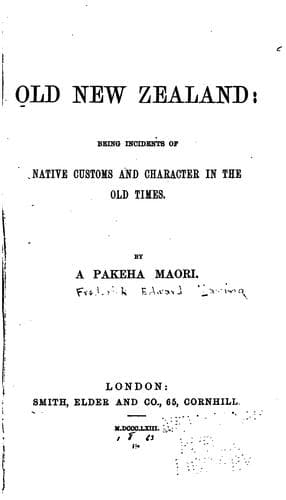
Old New Zealand: Being Incidents of Native Customs and Character in the Old TimesManing, Frederick Edward
History
Old New Zealand: Being Incidents of Native Customs and Character in the Old Times
Maning, Frederick Edward
Māori (New Zealand people); New Zealand -- Description and travel
In the hot days of summer, when his blood, I suppose, got a little
warm, he would sometimes become talkative, and recount the exploits of
his youth. As he warmed to the subject, he would seize his spear and go
through all the incidents of some famous combat, repeating every
thrust, blow, and parry, as they actually occurred, and going through
as much exertion as if he was really and truly fighting for his life.
He used to go through these pantomimic labours as a duty whenever he
had an assemblage of the young men of the tribe around him; to whom, as
well as to myself, he was most anxious to communicate that which he
considered the most valuable of all knowledge, a correct idea of the
uses of the spear, a weapon he really used in a most graceful and
scientific manner; but he would ignore the fact that "Young New
Zealand" had laid down the weapon for ever, and already matured a new
system of warfare adapted to their new weapons, and only listened to
his lectures out of respect to himself, and not for his science.
At last this old lion was taken seriously ill, and removed permanently
to the village; and one evening a smart, handsome lad, of about twelve
years of age, came to tell me that his _tupuna_ was dying, and had said
he would "go" to-morrow, and had sent for me to see him before he died.
The boy also added that the tribe were _ka poto_, or assembled, to the
last man, around the dying chief. I must here mention that, though this
old _rangatira_ was not the head of his tribe, he had been for about
half a century the recognized war chief of almost all the sections, or
_hapu_, of a very numerous and warlike _iwi_, or tribe, who had now
assembled from all their distant villages and pas to see him die. I
could not, of course, neglect the invitation, so at daylight next
morning I started on foot for the native village. On my arrival about
mid-day, I found it crowded by a great assemblage of natives. I was
saluted by the usual _haere mai!_ and a volley of musketry. I at once
perceived that, out of respect to my old owner, the whole tribe from
far and near, hundreds of whom I had never seen, considered it
necessary to make much of me,--at least for that day,--and I found
myself consequently at once in the position of a "personage." "Here
comes the pakeha!--_his_ pakeha!--make way for the pakeha!--kill those
dogs that are barking at the pakeha!" Bang! bang! Here a double barrel
nearly blew my cap off, by way of salute: I did for a moment think my
head was off. However, being quite _au fait_ in Maori etiquette by this
time, thanks to the instructions and example of my old friend, I fixed
my eyes with a vacant expression, looking only straight before me,
recognized nobody, and took notice of nothing; not even the muskets
fired under my nose or close to my back at every step, and each, from
having four or five charges of powder, making a report like a cannon.
On I stalked, looking neither to the right or the left, with my spear
Public-domain text, read in full here on John Shaqi.
Reviews
Reviews
No reviews yet
Be the first to share your thoughts on this work.
Elsewhere in the archive
Join the Discussion
Join the discussion
Sign in to leave a comment or review.
Sign InorCreate an account