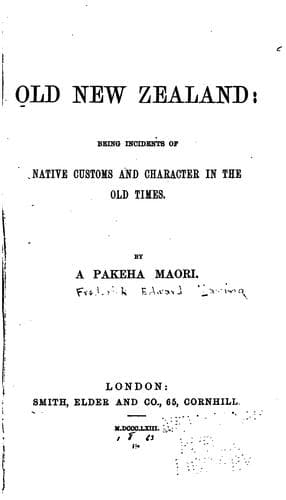
Old New Zealand: Being Incidents of Native Customs and Character in the Old TimesManing, Frederick Edward
History
Old New Zealand: Being Incidents of Native Customs and Character in the Old Times
Maning, Frederick Edward
Māori (New Zealand people); New Zealand -- Description and travel
_Torere_--An unfathomable cave, or pit, in the rocky mountains, where
the bones of the dead, after remaining a certain time in the first
burying place, are removed to and thrown in, and so finally disposed
of.--p. 72.
_Tu ngarahu_--This is a muster, or review, made to ascertain the
numbers and condition of a native force; generally made before the
starting of an expedition. It is, also, often held as a military
spectacle, or exhibition, of the force of a tribe when they happen to
be visited by strangers of importance: the war dance is gone through on
these occasions, and speeches declaratory of war, or welcome, as the
case may be, made to the visitors. The "review of the Taniwha,"
witnessed by the Ngati Kuri, was possibly a herd of sea-lions, or
sea-elephants; animals scarcely ever seen on the coast of that part of
New Zealand, and, therefore, from their strange and hideous appearance,
at once set down as an army of Taniwha. One man only was, at the defeat
of the Ngati Kuri, on Motiti, rescued to tell the tale.--p. 153.
_Tupara_--A double gun; an article, in the old times, valued by the
natives above all other earthly riches.--p. 12.
_Tutua_--A low, worthless, and, above all, a _poor_, fellow--a
"nobody."--p. 18.
_Utu_--Revenge, or satisfaction; also payment.--p. 26.
THE END.
London: SMITH, ELDER and Co., Little Green Arbour Court, Old Bailey,
E.C.
Public-domain text, read in full here on John Shaqi.
Reviews
Reviews
No reviews yet
Be the first to share your thoughts on this work.
Elsewhere in the archive
Join the Discussion
Join the discussion
Sign in to leave a comment or review.
Sign InorCreate an account