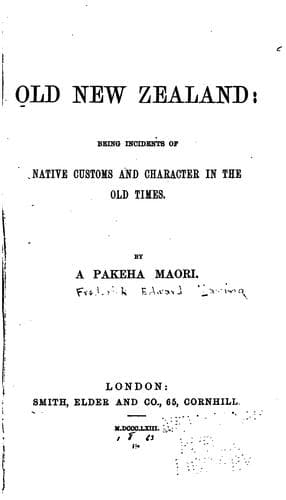
Old New Zealand: Being Incidents of Native Customs and Character in the Old TimesManing, Frederick Edward
History
Old New Zealand: Being Incidents of Native Customs and Character in the Old Times
Maning, Frederick Edward
Māori (New Zealand people); New Zealand -- Description and travel
_Ki au te mataika_--I have the _mataika_. The first man killed in a
battle was called the _mataika_. To kill the _mataika_. To kill the
_mataika_, or first man, was counted a very high honour, and the most
extraordinary exertions were made to obtain it. The writer once saw a
young warrior, when rushing with his tribe against the enemy, rendered
almost frantic by perceiving that another section of the tribe would,
in spite of all his efforts, be engaged first, and gain the honour of
killing the _mataika_. In this emergency he, as he rushed on, cut down
with a furious blow of his tomahawk, a sapling which stood in his way,
and gave the cry which claims the _mataika_. After the battle the
circumstances of this question in Maori chivalry having been fully
considered by the elder warriors, it was decided that the sapling tree
should, in this case, be held to be the true _mataika_, and that the
young man who cut it down should always claim, without question, to
have killed, or, as the natives say, "caught," the _mataika_ of that
battle.--p. 174.
_Mana_--As the meaning of this word is explained in the course of the
narrative, it is only necessary to say that in the sense in which it is
used here, it means dominion or authority.--p. 3.
_Mere ponamu_--A native weapon made of a rare green stone, and much
valued by the natives.--p. 24.
_Na! Na! mate rawa!_--This is the battle cry by which a warrior
proclaims, exultingly and tauntingly, the death of one of the
enemy.--p. 58.
_No hea_--Literally, from whence? Often used as a negative answer to an
inquiry, in which case the words mean that the thing inquired for is
not, or in fact is nowhere.--p. 2.
_Pakeha_--An Englishman; a foreigner.--p. 3.
_Rangatira_--A chief, a gentleman, a warrior. _Rangatira pakeha_--A
foreigner who is a gentleman (not a _tutua_, or nobody, as described
above), a _rich_ foreigner.--p. 20.
_Tangi_--A dirge, or song of lamentation for the dead. It was the
custom for the mourners, when singing the _tangi_, to cut themselves
severely on the face, breast, and arms, with sharp flints and shells,
in token of their grief. This custom is still practised, though in a
mitigated form. In past times, the mourners cut themselves dreadfully,
and covered themselves with blood from head to feet. See a description
of a _tangi_ further on.--p. 3.
_Taniwha_--A sea monster: more fully described further on.--p. 30.
_Taonga_--Goods; property.--p. 20.
_Taua_--A war party; or war expedition.--p. 42.
_Tena koutou_; _or Tenara ko koutou_--The Maori form of salutation,
equivalent to our "How do you do?"--p. 54.
_Tino tangata_--A "good man," in the language of the prize-ring; a
warrior; or literally, a very, or perfect man.--p. 30.
_Toa_--A warrior of pre-eminent courage; a hero.--p. 179.
Public-domain text, read in full here on John Shaqi.
Reviews
Reviews
No reviews yet
Be the first to share your thoughts on this work.
Elsewhere in the archive
Join the Discussion
Join the discussion
Sign in to leave a comment or review.
Sign InorCreate an account