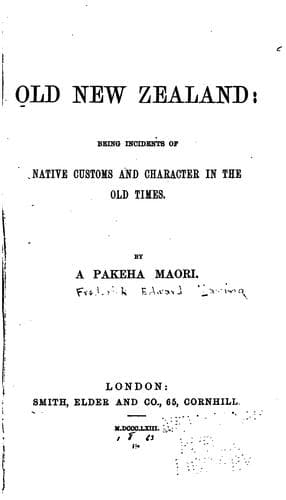
Old New Zealand: Being Incidents of Native Customs and Character in the Old TimesManing, Frederick Edward
History
Old New Zealand: Being Incidents of Native Customs and Character in the Old Times
Maning, Frederick Edward
Māori (New Zealand people); New Zealand -- Description and travel
Here the natives began to run between us to separate us, but seeing
that I was in the humour to "have it out," and that neither self nor
friend were actually out of temper--and, no doubt, expecting to see the
pakeha floored--they stood to one side and made a ring. A wrestler soon
recognizes another, and my friend soon gave me some hints that showed
me I had some work before me. I was a youngster in those days, all bone
and sinew, full of animal spirits, and as tough as leather. A couple of
desperate main strength efforts soon convinced us both that science or
endurance must decide the contest. My antagonist was a strapping fellow
of about five-and-twenty, tremendously strong, and much heavier than
me. I, however, in those days actually could not be fatigued: I did not
know the sensation, and I could run from morning till night. I
therefore trusted to wearing him out, and avoiding his _ta_ and _wiri_.
All this time the mob were shouting encouragement to one or other of
us. Such a row never was seen. I soon perceived I had a "party." "Well
done, pakeha!" "Now for it, Melons!" "At him again!" "Take care the
pakeha is a _taniwha_! the pakeha is a _tino tangata_!" "Hooray!" (from
the British element). "The pakeha is down!" "No, he isn't!" (from
English side). Here I saw my friend's knees beginning to tremble. I
made a great effort, administered my favourite remedy, and there lay
the "Eater of Melons" prone upon the sand.
I stood a victor; and, like many other conquerors, a very great loser.
There I stood, _minus_ hat, coat, and pistols; wet and mauled, and
transformed very considerably for the worse since I left the ship. When
my antagonist fell, the natives gave a great shout of triumph, and
congratulated me in their own way with the greatest good will. I could
see I had got their good opinion, though I scarcely could understand
how. After sitting on the sand some time, my friend arose, and with a
very graceful movement, and a smile of good-nature on his dusky
countenance, he held out his hand and said in English, "How do you do?"
I was much pleased at this; the natives had given me fair play, and my
antagonist, though defeated both by sea and land, offered me his hand,
and welcomed me to the shore with his whole stock of English--"How do
you do?"
Public-domain text, read in full here on John Shaqi.
Reviews
Reviews
No reviews yet
Be the first to share your thoughts on this work.
Join the Discussion
Join the discussion
Sign in to leave a comment or review.
Sign InorCreate an account