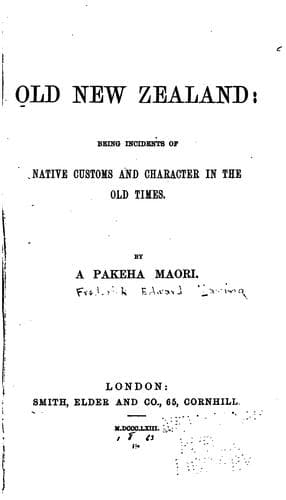
Old New Zealand: Being Incidents of Native Customs and Character in the Old TimesManing, Frederick Edward
History
Old New Zealand: Being Incidents of Native Customs and Character in the Old Times
Maning, Frederick Edward
Māori (New Zealand people); New Zealand -- Description and travel
I was fagged and confused. It was past mid-night; the company broke up,
and I went to a house where a bed had been prepared for me. I wished to
be quiet and alone; but it was fated there should be little quiet that
night. I was just falling asleep, after having thought for some time on
the extraordinary scenes I had witnessed, when I heard the report of a
musket at some little distance, followed by the shouting of men and the
screams of women. Out I rushed. I had a presentiment of some horrible
catastrophe. Men were running by, hastily armed. I could get no
information, so went with the stream. There was a bright flame
beginning to spring up at a short distance, and every one appeared
going in that direction: I was soon there.
A house had been set on fire to make a light. Before another house,
close at hand, a dense circle of human beings was formed. I pushed my
way through, and then saw, by the bright light of the flaming house, a
scene which is still fresh before me: there, in the verandah of the
house, was an old grey-bearded man; he knelt upon one knee, and on the
other he supported the dead body of the young girl who had said she
would follow the spirit to spirit land. The delicate-looking body from
the waist upwards was bare and bloody; the old man's right arm was
under the neck, the lower part of his long grey beard was dabbled with
blood, his left hand was twisting his matted hair; he did not weep, he
_howled_, and the sound was that of a heathen despair, knowing no hope.
The young girl had secretly procured a loaded musket, tied to the
trigger a loop for her foot, placed the muzzle to her tender breast,
and blown herself to shatters. And the old man was her father, and a
_tohunga_. A calm low voice now spoke close beside me, "She has
followed her _rangatira_," it said. I looked round, and saw the famous
_tohunga_ of the night.
Now, young ladies, I have promised not to frighten you with
raw-head-and-bloody-bones stories; a sort of thing I detest, but which
has been too much the fashion with folks who write of matters Maori. I
have vowed not to draw a drop of blood except in a characteristic
manner. But this story is tragedy, or I don't know what tragedy is; and
the more tragic because, in every particular, literally true: and so,
if you cannot find some pity for the poor Maori girl who "followed her
lord to spirit land," I shall make it my business not to fall in love
with any of you any more for I won't say how long.
CHAPTER XI.
The Local Tapu.--The Taniwha.--The Battle on Motiti.--The Death
of Tiki Whenua.--Reflections.--Brutus, Marcus Antonius, and Tiki
Whenua.--Suicide.
Public-domain text, read in full here on John Shaqi.
Reviews
Reviews
No reviews yet
Be the first to share your thoughts on this work.
Elsewhere in the archive
Join the Discussion
Join the discussion
Sign in to leave a comment or review.
Sign InorCreate an account