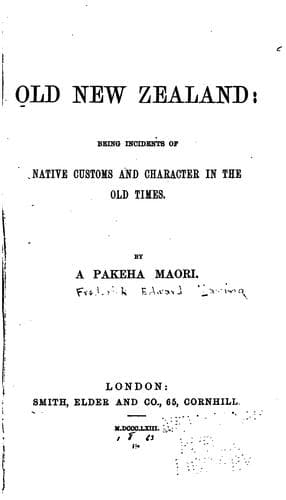
Old New Zealand: Being Incidents of Native Customs and Character in the Old TimesManing, Frederick Edward
History
Old New Zealand: Being Incidents of Native Customs and Character in the Old Times
Maning, Frederick Edward
Māori (New Zealand people); New Zealand -- Description and travel
A story-teller, like a poet or a pugilist, must be _born_, and not
_made_, and I begin to fancy I have not been born under a story-telling
planet, for by no effort that I can make can I hold on to the thread of
my story, and I am conscious the whole affair is fast becoming one
great parenthesis. If I could only get clear of this _tapu_ I would
"try back." I believe I ought to be just now completing the purchase of
my estate. I am sure I have been keeping house a long time before it is
built, which is I believe clear against the rules; so I must get rid of
this talk about the _tapu_ the best way I can, after which I will start
fair and try not to get before my story.
Besides these different forms of the _tapu_ which I have mentioned,
there were endless others; but the temporary local _tapus_ were the
most tormenting to a pakeha: as well they might, seeing that even a
native could not steer clear of them always. A place not _tapu_
yesterday might be most horribly _tapu_ to-day, and the consequences of
trespassing thereon proportionately troublesome.
Thus, sailing along a coast or a river bank, the most inviting
landing-place would be almost to a certainty the freehold property of
the Taniwha, a terrific sea monster, who would to a certainty, if his
landed property was trespassed on, upset the canoe of the trespassers
and devour them all the very next time they put to sea. The place was
_tapu_, and let the weather be as bad as it might, it was better to
keep to sea at all risks than to land there. Even pakeha, though in
some cases invulnerable, could not escape the fangs of the terrible
Taniwha. "Was not little Jackey-_poto_, the sailor, drowned by the
Taniwha? He _would_ go on shore, in spite of every warning, to get some
water to mix with his _waipiro_; and was not his canoe found next day
floating about with his paddle and two empty case-bottles in it?--a
sure sign that the Taniwha had lifted him out bodily. And was not the
body of the said Jackey found some days after with the Taniwha's mark
on it,--one eye taken out?"
These Taniwha would, however, sometimes attach themselves to a chief or
warrior, and in the shape of a huge sea monster, a bird, or a fish,
gambol round his canoe, and by their motions give presage of good or
evil fortune.
Public-domain text, read in full here on John Shaqi.
Reviews
Reviews
No reviews yet
Be the first to share your thoughts on this work.
Elsewhere in the archive
Join the Discussion
Join the discussion
Sign in to leave a comment or review.
Sign InorCreate an account