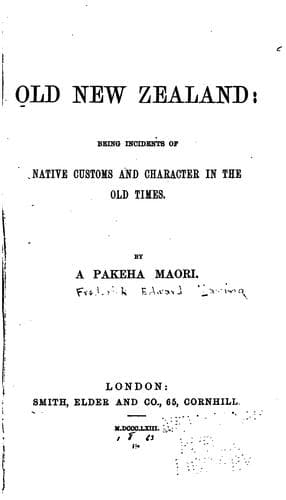
Old New Zealand: Being Incidents of Native Customs and Character in the Old TimesManing, Frederick Edward
History
Old New Zealand: Being Incidents of Native Customs and Character in the Old Times
Maning, Frederick Edward
Māori (New Zealand people); New Zealand -- Description and travel
Secondly.--In case of me being plundered or maltreated by any powerful
marauder, it was the duty of my chief to come in hot haste, with all
his family, armed to the teeth, to my rescue--after all was over, and
when it was too late to be of any service. He was also bound on such
occasions to make a great noise, dance the war dance, and fire muskets
(I finding the powder), and to declare loudly what he would have done
had he only been in time. I, of course, on such occasions, for my own
dignity, and in consideration of the spirited conduct of my friends,
was bound to order two or three fat pigs to be killed, and lots of
potatoes to be served out to the "army;" who were always expected to be
starving, as a general rule. A distribution of tobacco, in the way of
largess, was also a necessity of the case.
Thirdly.--In case of my losing anything of consequence by theft--a
thing which, as a veracious pakeha, I am bound to say, seldom happened:
the natives in those days being, as I have already mentioned, a very
law observing people (of the law of _muru_), had, indeed, little
occasion to steal; the above-named law answering their purposes in a
general way much better, and helping them pretty certainly to any
little matter they coveted: yet, as there are exceptions to all rules,
theft would sometimes be committed--and then, as I was saying, it
became the bounden duty of my _rangatira_ to get the stolen article
back, if he was able, and keep it for himself for his trouble, unless I
gave him something of more value in lieu thereof.
Under the above regulations, things went on pleasantly enough: the
chief being restrained, by public opinion and the danger of the pakeha
running away, from pushing his prerogative to the utmost limit; and the
pakeha, on the other hand, making the commonalty pay for the indirect
taxation he was subjected to; so that in general, after ten or fifteen
years' residence, he would not be much poorer than when he arrived:
unless, indeed, some unlucky accident happened, such as pakehas were
liable to sometimes in the good old times.
Mentioning "public opinion" as a restraint on the chiefs'
acquisitiveness, I must explain that a chief possessing a pakeha was
much envied by his neighbours, who, in consequence, took every
opportunity of scandalizing him, and blaming him for any rough plucking
process he might subject the said pakeha to; and should he, by any
awkward handling of this sort, cause the pakeha at last to run for it,
the chief would never hear the end of it from his own family and
connections: pakehas being, in those glorious old times, considered to
be geese who laid golden eggs, and it was held to be the very extreme
of foolishness and bad policy either to kill them, or, by too rough
handling, to cause them to fly away.
Public-domain text, read in full here on John Shaqi.
Reviews
Reviews
No reviews yet
Be the first to share your thoughts on this work.
Elsewhere in the archive
Join the Discussion
Join the discussion
Sign in to leave a comment or review.
Sign InorCreate an account