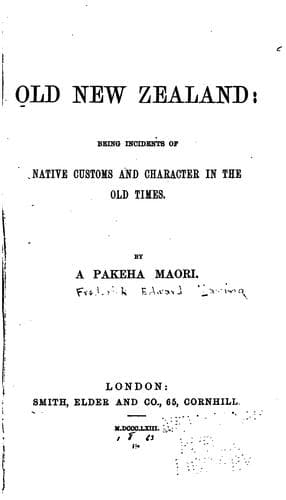
Old New Zealand: Being Incidents of Native Customs and Character in the Old TimesManing, Frederick Edward
History
Old New Zealand: Being Incidents of Native Customs and Character in the Old Times
Maning, Frederick Edward
Māori (New Zealand people); New Zealand -- Description and travel
On the other hand, should the pakeha fail in a culpable manner in the
performance of his duties--though he would not, as a rule, be subjected
to any stated punishment--he would soon begin to find a most
unaccountable train of accidents and all sorts of unpleasant
occurrences happening; enough, in the aggregate, to drive Job himself
out of his wits: and, moreover, he would _get a bad name_, which,
though he removed, would follow him from one end of the island to the
other, and effectually prevent him having the slightest chance of doing
any good,--that is, holding his own in the country; as the natives,
wherever he went, would consider him a person out of whom the most was
to be made at once, since he was not to be depended on as a source of
permanent revenue. I have known several industrious, active, and sober
pakehas who never could do any good, and whose lives, for a long series
of years, were a mere train of mishaps, till at last they were reduced
to extreme poverty; merely from having, in their first dealings with
the natives, got a bad name, in consequence of not having been able to
understand clearly the beauty of the set of regulations I have just
mentioned, and from an inability to make them work smoothly. The bad
name I have mentioned was short and expressive: wherever they went,
there would be sure to be some one who would introduce them to their
new acquaintances as "a pakeha _pakeke_,"--a hard pakeha; "a pakeha
_taehae_"--a miser; or, to sum up all, "a pakeha _kino_."
The chief who claimed me was a good specimen of the Maori _rangatira_.
He was a very old man, and had fought the French when Marion, the
French circumnavigator, was killed. He had killed a Frenchman himself,
and carried his thighs and legs many miles as a _bonne bouche_ for his
friends at home at the pa. This old gentleman was not head of his
tribe; but he was a man of good family, related to several high chiefs.
He was head of a strong family, or _hapu_, which mustered a
considerable number of fighting men; all his near relations. He had
been himself a most celebrated fighting man, and a war chief; and was
altogether a highly respectable person, and of great weight in the
councils of the tribe. I may say I was fortunate in having been
appropriated by this old patrician.
He gave me very little trouble; did not press his rights and privileges
too forcibly on my notice; and, in fact behaved in all respects towards
me in so liberal and friendly a manner, that before long I began to
have a very sincere regard for him, and he to take a sort of paternal
interest in me; this was both gratifying to observe, and also extremely
comical sometimes, when he, out of real anxiety to see me a perfectly
accomplished _rangatira_, would lecture on good manners, etiquette, and
the use of the spear. He was, indeed, a model of a _rangatira_, and
well worth being described.
Public-domain text, read in full here on John Shaqi.
Reviews
Reviews
No reviews yet
Be the first to share your thoughts on this work.
Elsewhere in the archive
Join the Discussion
Join the discussion
Sign in to leave a comment or review.
Sign InorCreate an account