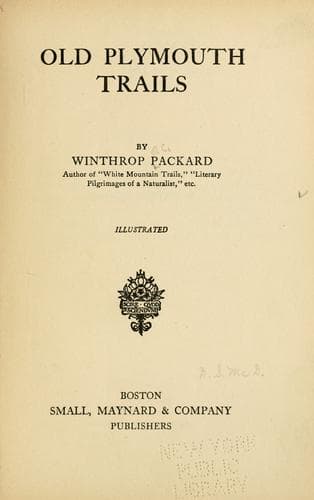
Natural history -- Massachusetts; Natural history -- Outdoor books; Plymouth County (Mass.)
It was the olden custom for host and guests to watch the first
burning of this ashen fagot, and as the hazel withes one by one
burned away the severing of the bond was the signal for the
passing of the flagon, the loosing of the genial hospitality pent
within the breasts of all and set free with the flames. Perhaps
many who took part in these rollicking ceremonials thought they
cared merely for the cakes and ale, but even they were self
deceived. It was the genial freeing of the spirit of Christmas
good-will to all, the fellowship that touched deepest, though they
may not have formulated the fact even in their thoughts. No wonder
that the children, whose clear sight is unblurred by too much
learning of things which are not so, knew that to this fond fire
on Christmas eve must come that patron saint of gifts, Santa
Claus, even though, the house being locked, he must climb down the
wide chimney to reach it. We have forgotten the shoe, which in the
folk tales of our earliest forbears of the North European forests
was the symbol of mutually helpful deeds of love. The children of
these days placed it by the Yule fire, that Santa Claus might load
it with gifts. Nowadays we hang the stocking in its stead, perhaps
because it holds more.
*****
I do not take it kindly of old Ben Franklin that he, almost an
hundred years ago, with his Poor Richard wisdom taught us to
economize our fuel by shutting up our fire in stoves, for what we
gained in the flesh we lost in the spirit, and it is good that in
the modern house, however mechanically complicated the heating
apparatus, we build fireplaces once again that our souls may be
warmed with the sight of the flame. The impulse to worship fire
still lingers within us and though we have better creeds than that
of Zoroaster and truer spiritual ideals than the Parsees we can
have no more appealing symbol of the purely spiritual than flame.
Phlogiston might well be another word for soul and we are unkind
to the old philosophers to take them too literally. The alchemists
were dreamers rather than doers after all, and though it is the
fashion to laud the doers it is often the dreamers that see most
clearly. As the flame leapt upward from the burning wood they saw
in it a rare, pure, ethereal substance which they called
Phlogiston.
Public-domain text, read in full here on John Shaqi.
Reviews
Reviews
No reviews yet
Be the first to share your thoughts on this work.
Elsewhere in the archive
Join the Discussion
Join the discussion
Sign in to leave a comment or review.
Sign InorCreate an account