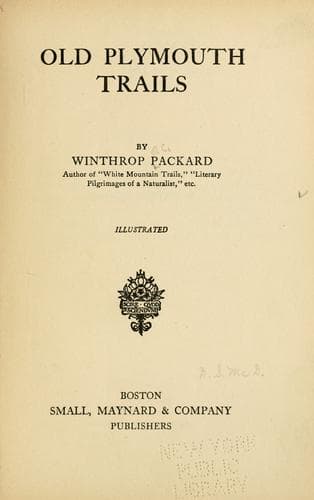
Natural history -- Massachusetts; Natural history -- Outdoor books; Plymouth County (Mass.)
Nor did they yield their theory when Lavoisier claimed to disprove
it by burning phosphorus in oxygen and weighing the result, which
was heavier than the phosphorus had been. Thereupon the world
derided the alchemists and lauded Lavoisier whose experiments laid
the foundation for the intricate science of modern chemistry. For
all that, science gives us the truth only from one angle and the
science of one age is often disproved by the science of the next.
Modern chemists may agree on what happens when phosphorus burns,
but many a theory of Lavoisier's day has been disproved in its
turn. A thousand scientists have declared flying impossible to
man, yet today men fly. Lavoisier was right, no doubt. Combustion
is the combination of an element with oxygen. He proved that with
his chemist's balance. Yet how did he prove that some imponderable
element does not leap from wood in flame? As well say that when a
man dies the spirit has not left the body because he weighs the
same. Watching the falling embers of the Yule log leap into flames
before they turn gray, I am apt to think that the intuition of the
alchemists touched a truth that the chemical apparatus missed. You
cannot measure its reaction on the mind of man or weigh the
results, but they are there.
*****
Wood was the sole fuel of the New England pioneers for two
centuries. In fact in many a remote farmhouse it is today, and the
fathers soon found by use which kind lighted quickest and which
burned longest and with the most steady heat, facts which the
subtle analysis of the chemists only confirmed. The conifers light
most readily and burn rapidly with the greatest heat in a given
time. The hard woods burn longest, some of them retaining fire for
a surprising length of time under just the right conditions. The
woodsmen will tell you that the pines light easily and burn
fiercely because of the pitch they contain. This is true but the
chemists have added another reason. Pine gives off much hydrogen
when heated and this light and inflammable gas gives much flame.
Even in pine wood which does not seem resinous to the touch there
is much of this volatile inflammable material and a good store of
pine kindlings is a first requisite in every well ordered country
household. Of the hard woods hickory is easily king as a fire
holder. Yet the oaks, white and red, and the sugar and black
maples are not far behind in value. Our American white ash and elm
rank well up with the oaks, so does beech, while the softer woods
fall behind. Moreover, trees grown on high, droughty, barren soil
show greater heating power than those of the same variety which
happen to stand in rich, but moister soil.
Public-domain text, read in full here on John Shaqi.
Reviews
Reviews
No reviews yet
Be the first to share your thoughts on this work.
Elsewhere in the archive
Join the Discussion
Join the discussion
Sign in to leave a comment or review.
Sign InorCreate an account