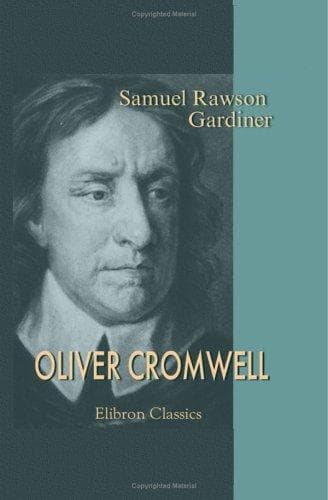
Cromwell, Oliver, 1599-1658; Great Britain -- History -- Commonwealth and Protectorate, 1649-1660
As for Cromwell, he settled down into a quiet and unpretentious life,
attending to the discipline of the army, and ready in his place in
Parliament to forward the cause which he had most at heart--the
establishment of that Commonwealth to which his victories had given a
breathing-space. To him, as to many disinterested observers, the time
had come to found the government no longer on the sword, but on the
consent of the nation, and there can be little doubt that at no time
between 1642 and 1660 was there more chance of gaining a majority for
the new system than this. Cromwell, at least, did everything in his
power to procure a vote for an early dissolution. It was only, however,
by a majority of two that Parliament agreed to fix a date for its
dissolution, following the vote by a resolution postponing that event
for three years. There can be little doubt that this resolution found
support amongst those members who were fattening on corruption; but
there was also something to be said for the view taken some time before
by Marten, when he compared the Commonwealth to Moses, because the
members now sitting 'were the true mother to this fair child, the young
Commonwealth,' and therefore its fittest nurses. A general election
is always somewhat of a lottery, and it was the weakest part of the
system--or want of system--on which the Commonwealth was based, that
it never represented the people as a whole, and that its actions might
easily have been repudiated by them if they had been consulted.
Baffled in his desire to secure an immediate appeal to the electors,
Cromwell prepared to use the time which the members had secured for
themselves, by coming to an understanding with the leading statesmen
on the principles of the future Government. He had never committed
himself to the doctrine that the executive authority ought to be
placed directly in the hands of an elected assembly or of a council
subordinated to it. When at the conference now held the lawyers
pleaded that Charles II. or the Duke of York might be called on to
accept the government if the rights of Englishmen could be safeguarded,
he replied somewhat oracularly: "That will be a business of more than
ordinary difficulty; but really, I think, if it may be done with safety
and preservation of our rights as Englishmen and Christians, that a
settlement with somewhat of a monarchical power in it would be very
effectual". It is very unlikely that Cromwell, being what he was, had
as yet formed any settled design in his own mind, but the tendency
towards the course which eventually established the Protectorate is
quite evident. To secure the rights of Englishmen and Christians rather
than to strengthen the absolute supremacy of Parliaments had been his
constant aim. Whether he reflected that if the monarchical power was
to be given to some one not of the House of Stuart, it could hardly be
given to any other man than himself, is a question which every one must
answer as he thinks fit.
Public-domain text, read in full here on John Shaqi.
Reviews
Reviews
No reviews yet
Be the first to share your thoughts on this work.
Elsewhere in the archive
Join the Discussion
Join the discussion
Sign in to leave a comment or review.
Sign InorCreate an account