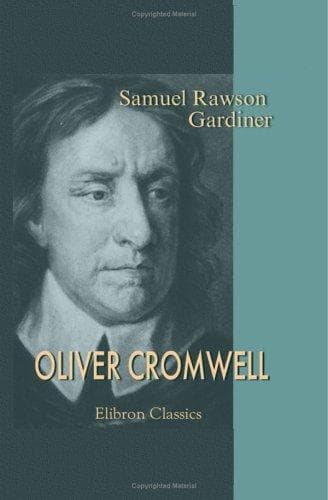
Cromwell, Oliver, 1599-1658; Great Britain -- History -- Commonwealth and Protectorate, 1649-1660
If the Commonwealth leaders were immersed in preparations for
war, the officers of the army had not forgotten their demand for
reforms in Church and State, and in contemplating the slackness of
Parliament with regard to these reforms, their minds were again set
on a dissolution of Parliament at a time far earlier than that which
had been fixed by the House itself. Towards the end of July the Army
Council--now composed of officers alone--had considered a petition to
be addressed to Parliament, and had asked 'that a new representative
be forthwith elected'. When the petition was finally submitted to
Parliament, this clause had given place to another merely requesting
Parliament to consider of some qualifications which would secure 'the
election only of such as are pious and faithful in the interests of
the Commonwealth to sit and serve as members in the said Parliament,'
in this way shifting from a demand for a dissolution to be followed
by a general election, to a demand for partial elections to fill up
existing vacancies. Though no direct evidence exists, there are strong
reasons for believing that this substitution was made in consequence of
Cromwell's intervention. Even then he did not append his signature to
the petition.
It was as a mediator--not as a partisan--that Cromwell bore himself
at the time when the army--after an interval of more than two years
and a half--once more began to put pressure on Parliament. On the one
hand Parliament was not only discredited by its inability to undertake
the reforms demanded, but still more by the widely spread belief
that many of its members had made full use of their opportunities
to feather their own nests. On the other hand, this discredited
House, though, mutilated as it was, it had scarcely a semblance of
constitutional right, was yet the only body remaining in existence to
which even a semblance appertained. Cromwell might not be an authority
on constitutional law, but he had an instinctive apprehension for the
truth on which all constitutional law is based--that the first thing
necessary in the institutions of any country is not that they shall
be theoretically defensible, but that they should meet with general
acceptance. Those who like ourselves can look back on that stirring
time from the safe vantage ground which we occupy, can see that, so far
as constitutional questions were concerned, the work of the men of the
seventeenth century was to substitute Parliament for the Crown as the
basis of authority, and we have, accordingly, considerable difficulty
in placing ourselves in the position of those to whom only part of the
drama had been unrolled. In 1652, at least, it was impossible to appeal
to the truncated Parliament as in any way representing the nation.
Yet how was it possible to base authority on any new Parliament which
should even approximate to such a representation? Except with extreme
theorists there was no desire to evoke such a spectre. Already in 1650
Public-domain text, read in full here on John Shaqi.
Reviews
Reviews
No reviews yet
Be the first to share your thoughts on this work.
Elsewhere in the archive
Join the Discussion
Join the discussion
Sign in to leave a comment or review.
Sign InorCreate an account