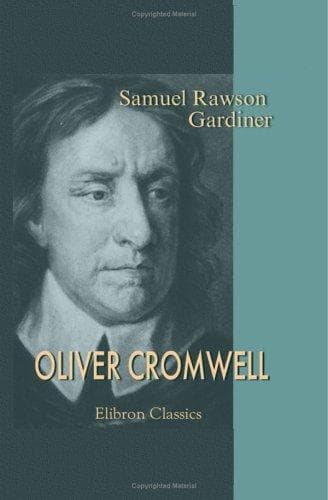
Cromwell, Oliver, 1599-1658; Great Britain -- History -- Commonwealth and Protectorate, 1649-1660
Though Milton, in his unpractical idealism, was for discontinuing all
public support to the clergy, whilst Cromwell, so far as we can judge,
was merely for substituting some other mode of payment for the unequal
burden of the tithe as it was levied in those days, they concurred on
the point of extending religious liberty to the uttermost, and in this
Cromwell had the army behind him. For the moment, however, the decision
was postponed, as the Commonwealth had become involved in a war which
occupied the thoughts of its rulers.
In the Dutch war, which broke out in 1652, neither Cromwell nor his
brother officers had much part. Ever since the beginning of the
Commonwealth a maritime war with France had virtually existed under
the pretext of reprisals for injury done by French ships to English
trade. The seizure of French goods in Dutch vessels had irritated the
Netherlanders, and the Navigation Act passed in 1651 had taken away
much of the trade done by them in English ports. In May, 1652, Tromp,
the great Dutch admiral, had been sent out with orders to resist the
right of search, and on approaching an English fleet commanded by
Blake, he had neglected to lower his flag, as required by English
commanders in satisfaction of their claim to enforce the Sovereignty
over the British Seas, a claim which the Commonwealth had received
from the Monarchy. An action resulting brought on war between the
two peoples. In this war, neither Cromwell nor the army sympathised.
Holding as they did that the force of England, if used at all, should
be used for the advantage of Protestantism, they disliked a war waged
against a Protestant nation. On the other hand they had no wish to
see the English navy playing a craven part; and believing that Tromp
had kept his flag flying as a studied insult, they offered no direct
opposition to the war. Yet, as long as it was in progress, whenever
any overture likely to lead to peace was made, it was sure to have the
support of Cromwell and the officers.
Public-domain text, read in full here on John Shaqi.
Reviews
Reviews
No reviews yet
Be the first to share your thoughts on this work.
Elsewhere in the archive
Join the Discussion
Join the discussion
Sign in to leave a comment or review.
Sign InorCreate an account