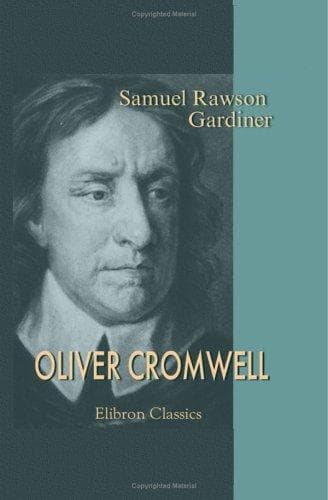
Cromwell, Oliver, 1599-1658; Great Britain -- History -- Commonwealth and Protectorate, 1649-1660
themselves and to continue the power in their own hands; their meddling
in private matters between party and party contrary to the institution
of Parliament, their injustice and partiality in those matters, and
the scandalous lives of some of the chief of them; these things, my
lord, do give much ground for people to open their mouths against
them and to dislike them; nor can they be kept within the bounds of
justice and law or reason, they themselves being the supreme power
of the nation, liable to no account of any, nor to be controlled or
regulated by any other power; there being none superior or co-ordinate
with them." Cromwell was evidently harking back to his proposal for
mixing something of monarchy with the existing institutions. "Unless,"
he continued, "there be some authority and power so full and so high
as to restrain and keep things in better order, and that may be a
check to these exorbitances, it will be impossible in human reason to
prevent our ruin." To Whitelocke's constitutional objections he replied
sharply: "What if a man should take upon him to be a King?" Whitelocke
replied that it would be better to recall Charles II. Cromwell's
utterance was plainly unpremeditated, and may be taken as a sign that
the idea of his own elevation was, even at this early date, present in
his mind, at least as a possibility, though it was far from having as
yet crystallised itself into a settled design.
It was no restoration of kingship, but the speedy choice of a new
Parliament that was in the thoughts of Cromwell's subordinates. In
January, 1653, a circular was sent by them to the regiments, asking
the soldiers, as well as the officers, to approve of a petition for
'successive Parliaments consisting of men faithful to the interests of
the Commonwealth, men of truth, fearing God and hating covetousness,'
as well as for law reform and liberty of conscience. For some time it
seemed as if Parliament would consent to hasten its own dissolution.
In March, however, though a bill for new elections was considered, the
pace slackened, and the hopes of the army again fell. In the army,
indeed, there was far from being complete unanimity. A party headed
by Lambert would have been content with a new Parliament from which
members hostile to the Commonwealth were excluded, whilst the perfervid
Harrison advocated the principles of the Fifth Monarchy, and asked that
the government should be entrusted to moral and religious men, without
recourse to popular election. Both Lambert and Harrison concurred
in urging Cromwell to proceed to a forcible dissolution. Cromwell
hesitated long. "I am pushed on," he complained, "by two parties to do
that, the consideration of the issue whereof makes my hair stand on
end."
Public-domain text, read in full here on John Shaqi.
Reviews
Reviews
No reviews yet
Be the first to share your thoughts on this work.
Elsewhere in the archive
Join the Discussion
Join the discussion
Sign in to leave a comment or review.
Sign InorCreate an account