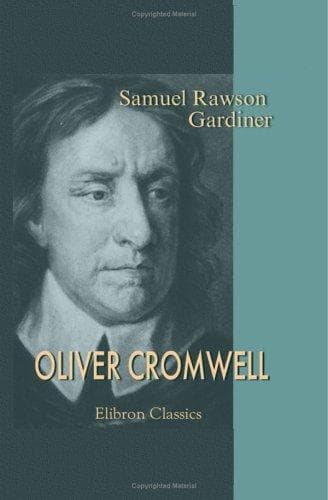
Cromwell, Oliver, 1599-1658; Great Britain -- History -- Commonwealth and Protectorate, 1649-1660
the earth--I would have been glad to have lived under my wood side
to have kept a flock of sheep, rather than to have undertaken such a
government as this. But undertaking it by the advice and petition of
you, I did look that you who had offered it unto me should make it
good."
Such language must appear to those who judge by the recorded words and
actions of this Parliament to be without adequate justification. It is
undeniable that the constitution contained no definition of the powers
of the new House, and if there had been no other than the ostensible
question at issue, it would have been unreasonable in Oliver to hurry
on a crisis before attempting, directly or indirectly, to suggest terms
of compromise. As a matter of fact this question of the other House was
very far from covering the whole ground of debate. A petition to which
thousands of signatures were appended was being circulated in the City,
asking for a complete restitution of Parliamentary supremacy and--no
doubt to catch the support of a certain section of the army--for an
enactment that no officer or soldier should be cashiered without the
sentence of a court martial. Oliver was perfectly right in holding
that the attack on the other House was equivalent to an assault on the
constitutional Protectorate. He had himself looked to that House as
restoring to him in another form the powers which he had abandoned when
he let fall the Instrument. By keeping in his own hands the selection
of its members, and providing that that House should have a veto on
subsequent nominations--the principle of inheritance being totally
excluded--he imagined that he had sufficiently provided for the future.
His objects in so doing may be taken as those set forth by a writer who
had ample means of gathering his intentions. "It was no small task for
the Protector to find idoneous men for this place, because the future
security of the honest interest seemed--under God--to be laid up in
them; for by a moral generation, if they were well chosen at the first,
they would propagate their own kind, when the single person could not,
and the Commons, who represented the nation, would not, having in them
for the most part the spirit of those they represent, which hath little
affinity with a respect of the cause of God." It is easy to criticise
such a principle from a modern point of view. Yet if the morality of
Oliver's political actions are ever to be judged fairly, it must never
be forgotten that the right of an honest Government to prevent the
people from injuring themselves by out-voting the saner members of the
community was--rather than any democratic or Parliamentary theory--the
predominant note of his career. It is this at least which explains his
assent to the choice of the nominated Parliament, as well as his breach
with the Parliaments which he dismissed in 1655 and 1658.
Public-domain text, read in full here on John Shaqi.
Reviews
Reviews
No reviews yet
Be the first to share your thoughts on this work.
Elsewhere in the archive
Join the Discussion
Join the discussion
Sign in to leave a comment or review.
Sign InorCreate an account