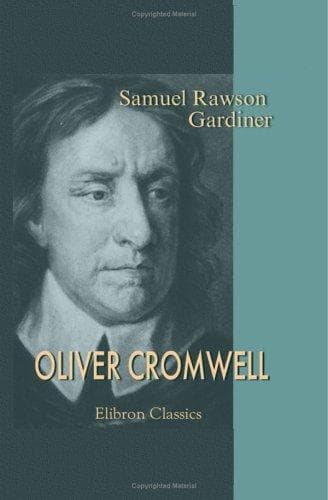
Cromwell, Oliver, 1599-1658; Great Britain -- History -- Commonwealth and Protectorate, 1649-1660
"Of this latter class Cromwell made himself the mouthpiece. Himself a
man of compromises, he had been thrust, sorely against his will, into
direct antagonism with the uncompromising King. He had striven long to
mediate between the old order and the new, first by restoring Charles
as a constitutional King, and afterwards by substituting one of his
children for him. Failing in this, and angered by the persistence with
which Charles stirred up Scottish armies and Irish armies against
England, Cromwell finally associated himself with those who cried out
most loudly for the King's blood. No one knew better than Cromwell that
it was folly to cover the execution of the King with the semblance of
constitutional propriety, and he may well have thought that, though
law and constitution had both broken down, the first step to be taken
towards their reconstruction was the infliction of the penalty of death
upon the man who had shown himself so wanting in the elementary quality
of veracity upon which laws and constitutions are built up. All that
is known of Cromwell's conduct at the trial points to his contempt for
the legal forms with which others were attempting to cover an action
essentially illegal."
A further question which has been often mooted is whether
Cromwell--whatever may be said on the purity of his motives--did not
commit a blunder in respect of the interests of himself and his cause.
If those who have discussed this problem mean that the attempt to
establish a free government during Cromwell's lifetime was rendered
more difficult by the execution of the King, it is hard to gainsay
their opinion, though the estrangement of the bulk of the population
from the new order, in consequence of the execution, is probably very
much exaggerated. Those who, like the Cavaliers, had been mulcted of
a portion of their estates had an additional reason for detesting a
government which had used them so ill, and there must have been a
certain number amongst the crowds who read the _Eikon Basilike_--the
little book in which Charles's vindication of his life was supposed
to have been written by his own hand--who were permanently affected
by that sentimental production of Dr. Gauden. If, however, it is
argued that Cromwell and his allies might possibly have succeeded in
establishing a government to their taste if they had abstained from
inflicting the last penalty on the King, it can only be answered that
other causes made their success in the highest degree improbable.
Their plans for the benefit of the people were on the one hand too
far advanced to secure popular support; and, on the other hand, too
defective in fair-play to their opponents to deserve it. Puritanism was
not, and never could be the national religion, and though it made more
enemies through its virtues than through its defects, those who strove
to enforce its moral and social precepts needed a strong military force
at their backs. The irritation caused by the interference of the army
Public-domain text, read in full here on John Shaqi.
Reviews
Reviews
No reviews yet
Be the first to share your thoughts on this work.
Elsewhere in the archive
Join the Discussion
Join the discussion
Sign in to leave a comment or review.
Sign InorCreate an account