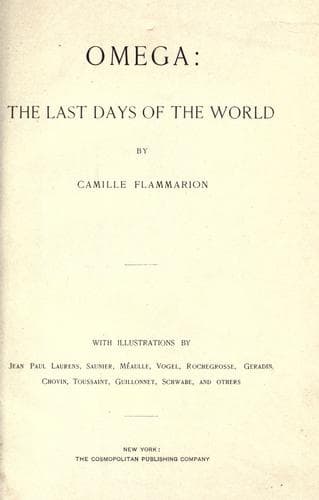
Omega: The Last days of the WorldFlammarion, Camille
Philosophy
Omega: The Last days of the World
Flammarion, Camille
End of the world -- Fiction; Science fiction
A human being dies every second, or about 86,000 a day, and an equal
number, or to speak more exactly, a little more than 86,000 are born
daily. This figure, true for the nineteenth century, applies to a long
period, if we increase it proportionately to the time. The population of
the globe has increased from epoch to epoch. In the time of Alexander
there were perhaps a thousand million living beings on the surface of
the earth. At the end of the nineteenth century fifteen hundred million;
in the twenty-second century two thousand million; in the twenty-ninth
three thousand million; at its maximum the population of the globe had
reached one hundred thousand million. Then it had begun to decrease.
Of the innumerable human bodies which have lived, not one remains. All
have been resolved into their elements, which have again formed new
individuals.
All that fills the passing day—labor, pleasure, grief and
happiness—vanishes with it into oblivion. Time flies, and the past
exists no longer; what has been, has disappeared in the gulf of
eternity. The visible world is vanishing every instant. Only the
invisible is real and enduring.
During the ten million years of history, the human race, surviving
generation after generation, as if it were a real thing, had been
greatly modified from both a physical and moral point of view. It had
always remained master of the world, and no new race had aspired to its
sovereignty; for races do not come down from heaven or rise from hell;
no Minerva is born full-armed, no Venus awakes full-grown in a shell of
pearl on the seashore; everything grows, and the human race, with its
long line of ancestry, was from the very beginning the natural result of
the vital evolution of the planet. Under the law of progress, it had
emerged from the limbo of animalism, and by the continued action of this
same law of progress it had become gradually perfected, modified and
refined.
But the time had come when the conditions of terrestrial life began to
fail; when humanity, instead of advancing, was itself to enter upon its
downward path.
The internal heat of the globe, still considerable in the nineteenth
century, although it had ceased to have any effect upon surface
temperature, which was maintained solely by the sun, had slowly
diminished, and the earth had, at last, become entirely cold. This had
not directly influenced the physical conditions of terrestrial life,
which continued to depend upon the atmosphere and solar heat. The
cooling of the earth cannot bring about the end of the world.
Public-domain text, read in full here on John Shaqi.
Reviews
Reviews
No reviews yet
Be the first to share your thoughts on this work.
Elsewhere in the archive
Join the Discussion
Join the discussion
Sign in to leave a comment or review.
Sign InorCreate an account