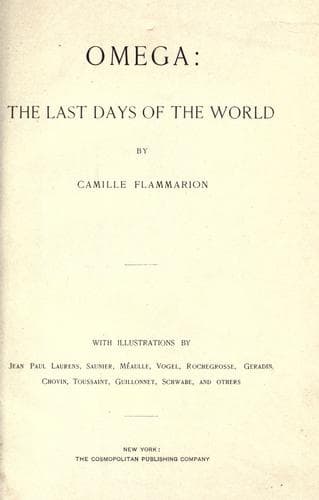
Omega: The Last days of the WorldFlammarion, Camille
Philosophy
Omega: The Last days of the World
Flammarion, Camille
End of the world -- Fiction; Science fiction
Imperceptibly, from century to century, the earth’s surface had become
levelled. The action of the rain, snow, frost and solar heat upon the
mountains, the waters of torrents, rivulets and rivers, had slowly
carried to the sea the débris of every continental elevation. The bottom
of the sea had risen, and in nine million years the mountains had almost
entirely disappeared. Meanwhile, the planet had grown old faster than
the sun; the conditions favorable to life had disappeared more rapidly
than the solar light and heat.
This conception of the planet’s future conforms to our present knowledge
of the universe. Doubtless, our logic is radically incomplete, puerile
even, in comparison with the real and eternal Truth, and might be justly
compared with that of two ants talking together about the history of
France. But, confessing the modesty which befits the finite in presence
of the infinite, and acknowledging our nothingness as compared with the
universe, we cannot avoid the necessity of appearing logical to
ourselves; we cannot assume that the abdication of reason is a better
proof of wisdom than the use of it. We believe that an intelligent order
presides over the universe and controls the destiny of worlds and their
inhabitants; that the larger members of the solar system must last
longer than the lesser ones, and, consequently, that the life of each
planet is not equally dependent upon the sun, and cannot, therefore,
continue indefinitely, any more than the sun itself. Moreover, direct
observation confirms this general conception of the universe. The earth,
an extinct sun, has cooled more rapidly than the sun. Jupiter, so
immense, is still in its youth. The moon, smaller than Mars, has reached
the more advanced stages of astral life, perhaps even has reached its
end. Mars, smaller than the earth, is more advanced than the earth and
less so than the moon. Our planet, in its turn, must die before Jupiter,
and this, also, must take place before the sun becomes extinct.
Consider, in fact, the relative sizes of the earth and the other
planets. The diameter of Jupiter is eleven times that of the earth, and
the diameter of the sun about ten times that of Jupiter. The diameter of
Saturn is nine times that of the earth. It seems to us, therefore,
natural to believe that Jupiter and Saturn will endure longer than our
planet, Venus, Mars or Mercury, those pigmies of the system!
Events justified these deductions of science. Dangers lay in wait for us
in the immensity of space; a thousand accidents might have befallen us,
in the form of comets, extinct or flaming suns, nebulæ, etc. But the
planet did not perish by an accident. Old age awaited the earth, as it
waits for all other things, and it grew old faster than the sun. It lost
the conditions necessary for life more rapidly than the central luminary
lost its heat and its light.
Public-domain text, read in full here on John Shaqi.
Reviews
Reviews
No reviews yet
Be the first to share your thoughts on this work.
Elsewhere in the archive
Join the Discussion
Join the discussion
Sign in to leave a comment or review.
Sign InorCreate an account