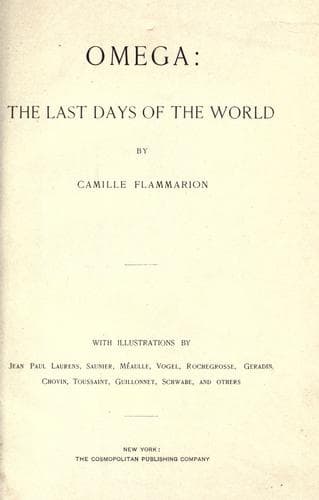
Omega: The Last days of the WorldFlammarion, Camille
Philosophy
Omega: The Last days of the World
Flammarion, Camille
End of the world -- Fiction; Science fiction
During the long periods of its vital splendor, when, leading the chorus
of the worlds, it bore on its surface an intelligent race, victors over
the blind forces of nature, a protecting atmosphere, beneath which went
on all the play of life and happiness, guarded its flourishing empires.
An essential element of nature, water, regulated terrestrial life; from
the very beginning this element had entered into the composition of
every substance, vegetable, animal and human. It formed the active
principle of atmospheric circulation; it was the chief agent in the
changes of climate and seasons; it was the sovereign of the terrestrial
state.
From century to century the quantity of water in the sea, the rivers and
the atmosphere diminished. A portion of the rain water was absorbed by
the earth, and did not return to the sea; for, instead of flowing into
the sea over impermeable strata, and so forming either springs or
subterranean and submarine watercourses, it had filtered deeper within
the surface, insensibly filling every void, every fissure, and
saturating the rocks to a great depth. So long as the internal heat of
the globe was sufficient to prevent the indefinite descent of this
water, and to convert it into vapor, a considerable quantity remained
upon the surface; but the time came when the internal heat of the globe
was entirely dispersed in space and offered no obstacle to infiltration.
Then the surface water gradually diminished; it united with the rocks,
in the form of hydrates, and thus disappeared from circulation.
Indeed, were the loss of the surface water of the globe to amount only
to a few tenths of a millimeter yearly, in ten million years none would
remain.
This vapor of water in the atmosphere had made warmth and life possible;
with its disappearance came cold and death. If at present the aqueous
vapor of the atmosphere should disappear, the heat of the sun would be
incapable of maintaining animal and vegetable life; life which,
moreover, could not exist, inasmuch as vegetables and animals are
chiefly composed of water.[4]
Footnote 4:
Public-domain text, read in full here on John Shaqi.
Reviews
Reviews
No reviews yet
Be the first to share your thoughts on this work.
Elsewhere in the archive
Join the Discussion
Join the discussion
Sign in to leave a comment or review.
Sign InorCreate an account