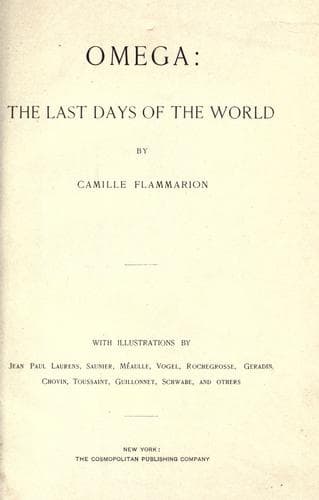
Omega: The Last days of the WorldFlammarion, Camille
Philosophy
Omega: The Last days of the World
Flammarion, Camille
End of the world -- Fiction; Science fiction
Human intelligence had so completely mastered the forces of nature that
it seemed as if so glorious an era never could come to an end. The
decrease in the amount of water, however, commenced to alarm even the
most optimistic. The great oceans had disappeared. The crust of the
earth, once so thin and mobile, had gradually increased in thickness,
and, notwithstanding the internal pressure, the earth had become almost
completely solidified. Oscillations of the surface were no longer
possible, for it had become entirely rigid. The seas which remained were
confined to the tropics. The poles were frozen. The continents of olden
times, where so many other foci of civilization had shone so
brilliantly, were immense deserts. Step by step humanity had migrated
towards the tropical zone, still watered by streams, lakes and seas.
There were no more mountains, no more condensers of snow.
[Illustration:
“RUDIMENTARY SPECIES OF CRYPTOGAMS ONLY SURVIVED.”
]
As the quantity of water and rainfall diminished, and, as the springs
failed and the aqueous vapor of the atmosphere grew less, vegetation had
entirely changed its aspect, increasing the volume of its leaves and the
length of its roots, seeking in every way to absorb the humidity
necessary for life. Species which had not been able to adjust themselves
to the new conditions had vanished; the rest were transformed. Not a
tree or a plant with which we are familiar was to be seen. There were no
oaks, nor ashes, nor elms, nor willows, and the landscape bore no
resemblance to that of today. Rudimentary species of cryptogams only
survived.
Like changes had taken place in the animal kingdom. Animal forms had
been greatly modified. The wild species had either disappeared or been
domesticated. The scarcity of water had modified the food of herbivora
as well as carnivora. The most recent species, evolved from those which
preceded them, were smaller, with less fat and a larger skeleton. The
number of plants had sensibly decreased. Less of the carbonic acid of
the air was absorbed, and a proportionally greater quantity existed in
the atmosphere. As for the human race, its metamorphosis was so absolute
that it was with an astonishment bordering on incredulity that one saw
in geological museums fossil specimens of men of the twentieth or one
hundredth century, with great brutal teeth and coarse intestines; it was
difficult to admit that organisms so gross could really be the ancestors
of intellectual man.
Though millions of years had passed, the sun still poured upon the earth
almost the same quantity of heat and light. At most, the loss had not
exceeded one-tenth. The only difference was that the sun appeared a
little yellower and a little smaller.
Public-domain text, read in full here on John Shaqi.
Reviews
Reviews
No reviews yet
Be the first to share your thoughts on this work.
Elsewhere in the archive
Join the Discussion
Join the discussion
Sign in to leave a comment or review.
Sign InorCreate an account