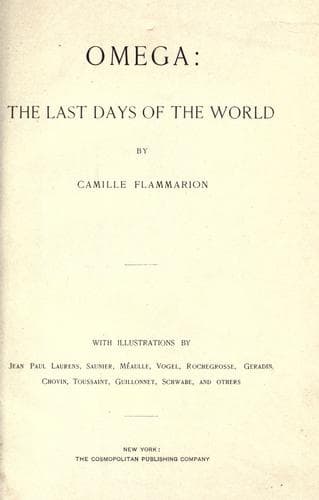
Omega: The Last days of the WorldFlammarion, Camille
Philosophy
Omega: The Last days of the World
Flammarion, Camille
End of the world -- Fiction; Science fiction
The moon still revolved about the earth, but more slowly. Its distance
from the earth had increased and its _apparent_ diameter had diminished.
At the same time the period of the earth’s rotation had lengthened. This
slower rotatory motion of the earth, increase in the distance of the
moon, and lengthening of the lunar month, were the results of the
friction of the tides, whose action resembled that of a brake. If the
earth and the moon last long enough, and there are still oceans and
tides, calculation would enable us to predict that the time would come
when the periodic time of the earth’s rotation would finally equal the
lunar month, so that there would be but five and one-quarter days in the
year: the earth would then always present the same side to the moon. But
this would require more than 150 million years. The period of which we
are speaking, ten million years, is but a fifteenth of the above; and
the time of the earth’s rotation, instead of being seventy times, was
only four and one-half times greater than it now is, or about 110 hours.
These long days exposed the earth to the prolonged action of the sun,
but except in those regions where its rays were normal to the surface,
that is to say in the equatorial zone between the two tropical circles,
this exposure availed nothing; the obliquity of the ecliptic had not
changed; the inclination of the axis of the earth being the same, about
two degrees, and the changes in the eccentricity of the earth’s orbit
had produced no sensible effect upon the seasons or the climate.
The human form, food, respiration, organic functions, physical and
intellectual life, ideas, opinions, religion, science, language—all had
changed. Of present man almost nothing survived.
[Illustration]
[Illustration]
CHAPTER IV.
The last habitable regions of the globe were two wide valleys near the
equator, the basins of dried up seas; valleys of slight depth, for the
general level was almost absolutely uniform. No mountain peaks, ravines
or wild gorges, not a single wooded valley or precipice was to be seen;
the world was one vast plain, from which rivers and seas had gradually
disappeared. But as the action of meteorological agents, rainfall and
streams, had diminished in intensity with the loss of water, the last
hollows of the sea bottom had not been entirely filled up, and shallow
valleys remained, vestiges of the former structure of the globe. In
these a little ice and moisture were left, but the circulation of water
in the atmosphere had ceased, and the rivers flowed in subterranean
channels as in invisible veins.
Public-domain text, read in full here on John Shaqi.
Reviews
Reviews
No reviews yet
Be the first to share your thoughts on this work.
Elsewhere in the archive
Join the Discussion
Join the discussion
Sign in to leave a comment or review.
Sign InorCreate an account