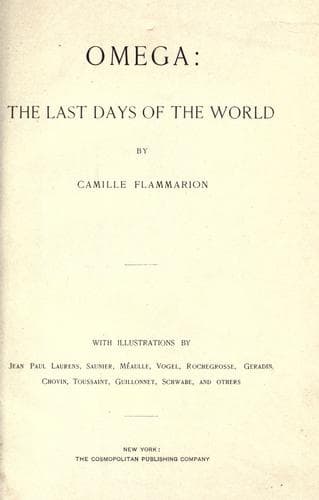
Omega: The Last days of the WorldFlammarion, Camille
Philosophy
Omega: The Last days of the World
Flammarion, Camille
End of the world -- Fiction; Science fiction
If the earth should fall into the sun, it would make good for
ninety-five years the actual loss of solar energy; Venus would make good
this loss for eighty-four years; Mercury for seven; Mars for thirteen;
Jupiter for 32,254; Saturn for 9652; Uranus for 1610; and Neptune for
1890 years. That is to say, the fall of all the planets into the sun
would produce heat enough to maintain the present rate of expenditure
for about 46,000 years.
It is therefore certain that the fall of meteors greatly lengthens the
life of the sun. One thirty-third millionth of the solar mass added each
year would compensate for the loss, and half of this would be sufficient
if we admit that condensation shares equally with the fall of meteorites
in the maintenance of solar heat; centuries would have to pass before
any acceleration of the planets’ velocities would be apparent.
Owing to these two causes alone we may, therefore, admit a future for
the sun of at least twenty million years; and this period cannot but be
increased by other unknown causes, to say nothing of an encounter with a
swarm of meteorites.
The sun therefore was the last living member of the system; the last
animated by the warmth of life.
But the sun also went out. After having so long poured upon his
celestial children his vivifying beams, the black spots upon his surface
increased in number and in extent, his brilliant photosphere grew dull,
and his hitherto dazzling surface became congealed. An enormous red ball
took the place of the dazzling center of the vanished worlds.
For a long time this enormous star maintained a high surface
temperature, and a sort of phosphorescent atmosphere; its virgin soil,
illumined by the light of the stars and by the electric influences which
formed a kind of atmosphere, gave birth to a marvelous flora, to an
unknown fauna, to beings differing absolutely in organization from those
who had succeeded each other upon the worlds of its system.
But for the sun also the end came, and the hour sounded on the timepiece
of destiny when the whole solar system was stricken from the book of
life. And one after another the stars, each one of which is a sun, a
solar system, shared the same fate; yet the universe continued to exist
as it does today.
Ψ
The science of mathematics tells us: “The solar system does not appear
to possess at present more than the one four hundred and fifty-fourth
part of the transformable energy which it had in the nebulous state.
Although this remainder constitutes a fund whose magnitude confounds our
imagination, it will also some day be exhausted. Later, the
transformation will be complete for the entire universe, resulting in a
general equilibrium of temperature and pressure.
Public-domain text, read in full here on John Shaqi.
Reviews
Reviews
No reviews yet
Be the first to share your thoughts on this work.
Elsewhere in the archive
Join the Discussion
Join the discussion
Sign in to leave a comment or review.
Sign InorCreate an account