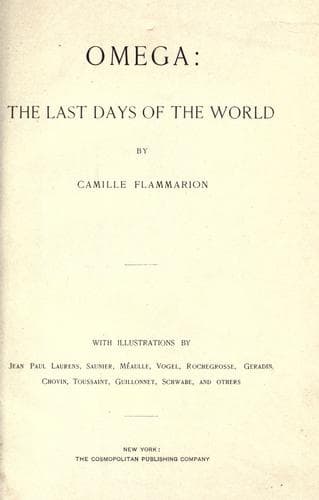
Omega: The Last days of the WorldFlammarion, Camille
Philosophy
Omega: The Last days of the World
Flammarion, Camille
End of the world -- Fiction; Science fiction
“Energy will not then be susceptible of transformation. This does not
mean annihilation, a word without meaning, nor does it mean the absence
of motion, properly speaking, since the same sum of energy will always
exist in the form of atomic motion, but the absence of all sensible
motion, of all differentiation, the absolute uniformity of conditions,
that is to say, absolute death.”
Such is the present statement of the science of mathematics.
Experiment and observation prove that on the one hand the quantity of
matter, and on the other hand the quantity of energy also, remains
constant, whatever the change in form or in position; but they also show
that the universe tends to a state of equilibrium, a condition in which
its heat will be uniformly distributed.
The heat of the sun and of all the stars seems to be due to the
transformation of their initial energy of motion, to molecular impacts;
the heat thus generated is being constantly radiated into space, and
this radiation will go on until every sun is cooled down to the
temperature of space itself.
If we admit that the sciences of today, mechanics, physics and
mathematics, are trustworthy, and that the laws which now control the
operations of nature and of reason are permanent, this must be the fate
of the universe.
Far from being eternal, the earth on which we live has had a beginning.
In eternity a hundred million years, a thousand million years or
centuries, are as a day. There is an eternity behind us and before us,
and all apparent duration is but a point. A scientific investigation of
nature and acquaintance with its laws raises, therefore, the question
already raised by the theologians, whether Plato, Zoroaster, Saint
Augustine, Saint Thomas Aquinas, or some young seminarist who has just
taken orders: “What was God doing before the creation of the universe,
and what will he do after its end?” Or, under a less anthromorphic form,
since God is unknowable: “What was the condition of the universe prior
to the present order of things, and what will it be after this order has
passed away?”
Note that the question is the same, whether we admit a personal God,
reasoning and acting toward a definite end, or, whether we deny the
existence of any spiritual being, and admit only the existence of
indestructible atoms and forces representing an invariable sum of
energy.
In the first case, why should God, an eternal and uncreated power,
remain inactive? Or, having remained inactive, satisfied with the
absolute infinity of his nature which nothing could augment, why did he
change this state and create matter and force?
Public-domain text, read in full here on John Shaqi.
Reviews
Reviews
No reviews yet
Be the first to share your thoughts on this work.
Elsewhere in the archive
Join the Discussion
Join the discussion
Sign in to leave a comment or review.
Sign InorCreate an account