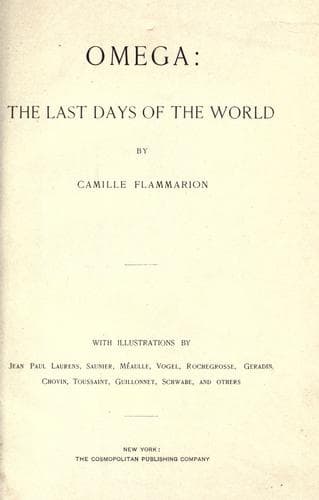
Omega: The Last days of the WorldFlammarion, Camille
Philosophy
Omega: The Last days of the World
Flammarion, Camille
End of the world -- Fiction; Science fiction
The theologian may reply: “Because it was his good pleasure.” But
philosophy is not satisfied with this change in the divine purpose. In
the second case, since the origin of the present condition of things
only dates back a certain time, and since there can be no effect without
a cause, we have the right to ask what was the condition of things
anterior to the formation of the present universe.
Although energy is indestructible, we certainly cannot deny the tendency
toward its universal dissipation, and this must lead to absolute repose
and death, for the conclusions of mathematics are irresistible.
Nevertheless, we do not concede this.
Why?
Because the universe is not a definite quantity.
Ω
It is impossible to conceive of a limit to the extension of matter.
Limitless space, the inexhaustible source of the transformation of
potential energy into visible motion, and thence into heat and other
forces, confronts us, and not a simple, finished piece of mechanism,
running like a clock and stopping forever.
The future of the universe is its past. If the universe were to have had
an end, this end would have been reached long ago, and we should not be
here to study this problem.
It is because our conceptions are finite, that things have a beginning
and an end. We cannot conceive of an absolutely endless series of
transformations, either in the future or in the past, nor that an
equally endless series of material combinations, of planets, suns,
sun-systems, milky ways, stellar universes, can succeed each other.
Nevertheless, the heavens are there to show us the infinite. Nor can we
comprehend any better the infinity of space or of time; yet it is
impossible for us to conceive of a limit to either, for our thought
overleaps the limit, and is impotent to conceive of bounds beyond which
there is no space nor time. One may travel forever, in any direction,
without reaching a boundary, and as soon as anyone affirms that at a
certain moment duration ceases, we refuse our assent; for we cannot
confound time with the human measures of it.
These measures are relative and arbitrary; but time itself exists, like
space, independently of them. Suppress everything, space and time would
still remain; that is to say, space which material things may occupy,
and the possibility of the succession of events. If this were not so,
neither space nor time would be really measurable, not even in thought,
since thought would not exist. But it is impossible for the mind even to
suppress either the one or the other. Strictly speaking, it is neither
space nor time that we are speaking of, but infinity and eternity,
relative to which every measure, however great, is but a point.
Public-domain text, read in full here on John Shaqi.
Reviews
Reviews
No reviews yet
Be the first to share your thoughts on this work.
Elsewhere in the archive
Join the Discussion
Join the discussion
Sign in to leave a comment or review.
Sign InorCreate an account