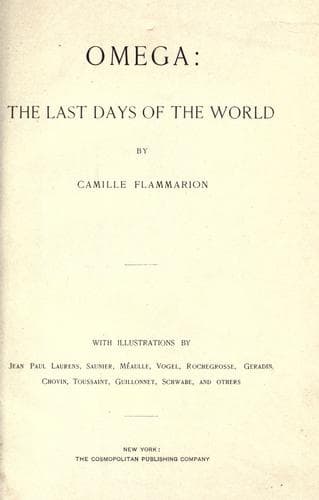
Omega: The Last days of the WorldFlammarion, Camille
Philosophy
Omega: The Last days of the World
Flammarion, Camille
End of the world -- Fiction; Science fiction
The director of the observatory of Paris was naturally to be the first
speaker; but what seemed to excite the greatest interest in the public
was the opinion of the president of the academy of medicine on the
probable effects of carbonic-oxide. The president of the geological
society of France was also to make an address, and the general object of
the session was to pass in review all the possible ways in which our
earth might come to an end. Evidently, however, the discussion of its
collision with the comet would hold the first place.
[Illustration:
FRIGHTENED WATCHERS.
]
As we have just seen, the threatening star hung above every head;
everybody could see it; it was growing larger day by day; it was
approaching with an increasing velocity; it was known to be at a
distance of only 17,992,000 kilometers, and that this distance would be
passed over in five days. Every hour brought this menacing hand, ready
to strike, 149,000 kilometers nearer. In six days anxious humanity would
breathe freely—or not at all.
[Illustration:
A GROUP OF LISTENERS.
]
CHAPTER III.
Never, within the history of man, had the immense hemicycle, constructed
at the end of the twentieth century, been invaded by so compact a crowd.
It would have been mechanically impossible for another person to force
an entrance. The amphitheater, the boxes, the tribunes, the galleries,
the aisles, the stairs, the corridors, the doorways, all, to the very
steps of the platform, were filled with people, sitting or standing.
Among the audience were the president of the United States of Europe,
the director of the French republic, the directors of the Italian and
Iberian republics, the chief ambassador of India, the ambassadors of the
British, German, Hungarian and Muscovite republics, the king of the
Congo, the president of the committee of administrators, all the
ministers, the prefect of the international exchange, the
cardinal-archbishop of Paris, the director-general of telephones, the
president of the council of aerial navigation and electric roads, the
director of the international bureau of time, the principal astronomers,
chemists, physiologists and physicians of France, a large number of
state officials (formerly called deputies or senators), many celebrated
writers and artists, in a word, a rarely assembled galaxy of the
representatives of science, politics, commerce, industry, literature and
every sphere of human activity. The platform was occupied by the
president, vice-presidents, permanent secretaries and orators of the
day, but they did not wear, as formerly, the green coat and chapeau or
the old-fashioned sword, they were dressed simply in civil costume, and
for two centuries and a half every European decoration had been
suppressed; those of central Africa, on the contrary, were of the most
brilliant description.
[Illustration:
A DOMESTICATED MONKEY.
]
Public-domain text, read in full here on John Shaqi.
Reviews
Reviews
No reviews yet
Be the first to share your thoughts on this work.
Join the Discussion
Join the discussion
Sign in to leave a comment or review.
Sign InorCreate an account