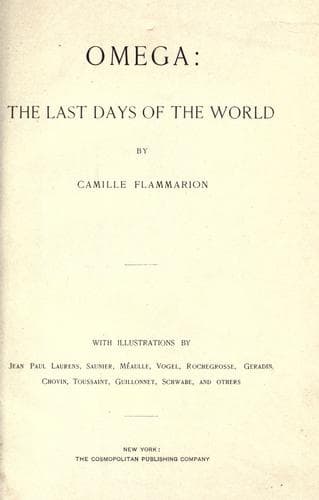
Omega: The Last days of the WorldFlammarion, Camille
Philosophy
Omega: The Last days of the World
Flammarion, Camille
End of the world -- Fiction; Science fiction
“These properties are terrible; why not confess it? For the most
infinitesimal quantity of this gas in the air we breathe is sufficient
to arrest in three minutes the normal action of the lungs and to destroy
life.
“Everybody knows that carbonic-oxide (known in chemistry as CO) is a
permanent gas without odor, color or taste, and nearly insoluble in
water. Its density in comparison with the air is 0.96. It burns in the
air with a blue flame of slight illuminating power, like a funereal
fire, the product of this combustion being carbonic anhydride.
“Its most notable property is its tendency to absorb oxygen. (The orator
dwelt upon these two words with great emphasis.) In the great iron
furnaces, for example, carbon, in the presence of an insufficient
quantity of air, becomes transformed into carbonic-oxide, and it is
subsequently this oxide which reduces the iron to a metallic state, by
depriving it of the oxygen with which it was combined.
“In the sunlight carbonic-oxide combines with chlorine and gives rise to
an oxychlorine (COCL^2)—a gas with a disagreeable, suffocating odor.
“The fact which deserves our more serious attention, is that this gas is
of the most poisonous character—far more so than carbonic anhydride. Its
effect upon the hemoglobin is to diminish the respiratory capacity of
the blood, and even in very small doses, by its cumulative effect,
hinders, to a degree altogether out of proportion to the apparent cause,
the oxygenizing properties of the blood. For example: blood which
absorbs from twenty-three to twenty-four cubic centimeters of oxygen per
hundred volumes, absorbs only one-half as much in an atmosphere which
contains less than one-thousandth part of carbonic-oxide. The
one-ten-thousandth part even has a deleterious effect, sensibly
diminishing the respiratory action of the blood. The result is not
simple asphyxia, but an almost instantaneous blood-poisoning.
Carbonic-oxide acts directly upon the blood corpuscles, combining with
them and rendering them unfit to sustain life: hematosis, that is, the
conversion of venous into arterial blood, is arrested. Three minutes are
sufficient to produce death. The circulation of the blood ceases. The
black venous blood fills the arteries as well as the veins. The latter,
especially those of the brain, become surcharged, the substance of the
brain becomes punctured, the base of the tongue, the larynx, the
wind-pipe, the bronchial tubes become red with blood, and soon the
entire body presents the characteristic purple appearance which results
from the suspension of hematosis.
Public-domain text, read in full here on John Shaqi.
Reviews
Reviews
No reviews yet
Be the first to share your thoughts on this work.
Join the Discussion
Join the discussion
Sign in to leave a comment or review.
Sign InorCreate an account