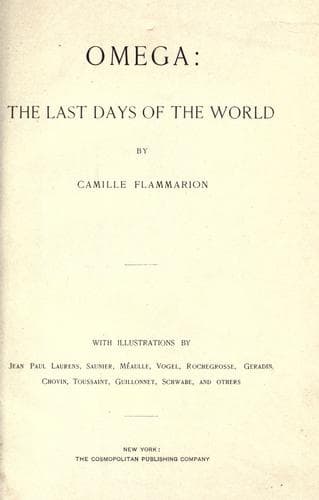
Omega: The Last days of the WorldFlammarion, Camille
Philosophy
Omega: The Last days of the World
Flammarion, Camille
End of the world -- Fiction; Science fiction
This speech, uttered with the tone of conviction, in a clear, calm and
solemn voice, again plunged the entire audience into a state of mind
from which the preceding address had, happily, released them. The
certainty of the approaching disaster was painted upon every face; some
had become yellow, almost green; others suddenly became scarlet and
seemed on the verge of apoplexy. Some few among the audience appeared to
have retained their self-possession, through scepticism or a philosophic
effort to make the best of it. A vast murmur filled the room; everyone
whispered his opinions to his neighbor, opinions generally more
optimistic than sincere, for no one likes to appear afraid.
The president of the astronomical society of France rose in his turn and
advanced toward the tribune. Instantly every murmur was hushed. Below we
give the main points of his speech, including the opening remarks and
the peroration:
“Ladies and gentlemen: After the statements which we have just heard, no
doubt can remain in any mind as to the certainty of the collision of the
comet with the earth, and the dangers attending this event. We must,
therefore, expect on Saturday—”
“On Friday,” interrupted a voice from the desk of the Institute.
“On Saturday, I repeat,” continued the orator, without noticing the
interruption, “an extraordinary event, one absolutely unique in the
history of the world.
“I say Saturday, although the papers announce that the collision will
take place on Friday, because it cannot occur before July 14th. I passed
the entire night with my learned colleague in comparing the observations
received, and we discovered an error in their transmission.”
This statement produced a sensation of relief among the audience; it was
like a slender ray of light in the middle of a somber night. A single
day of respite is of enormous importance to one condemned to death.
Already chimerical projects formed in every mind; the catastrophe was
put off; it was a kind of reprieve. It was not remembered that this
diversion was of a purely cosmographic nature, relating to the date and
not to the fact of the collision. But the least things play an important
role in public opinion. So it was not to be on Friday!
“Here,” he said, going to the black-board, “are the elements as finally
computed from all the observations.” The speaker traced upon the
black-board the following figures:
Perihelion passage August 11, at 0h., 42m., 44s.
Longitude of perihelion, 52°, 43´, 25˝.
Perihelion distance, 0.7607.
Inclination, 103°, 18´, 35˝.
Longitude of ascending node, 112°, 54´, 40˝.
“The comet,” he resumed, “will cross the ecliptic in the direction of
the descending node 28 minutes, 23 seconds after midnight of July 14th
just as the earth reaches the point of crossing. The attraction of the
earth will advance the moment of contact by only thirty seconds.
Public-domain text, read in full here on John Shaqi.
Reviews
Reviews
No reviews yet
Be the first to share your thoughts on this work.
Join the Discussion
Join the discussion
Sign in to leave a comment or review.
Sign InorCreate an account