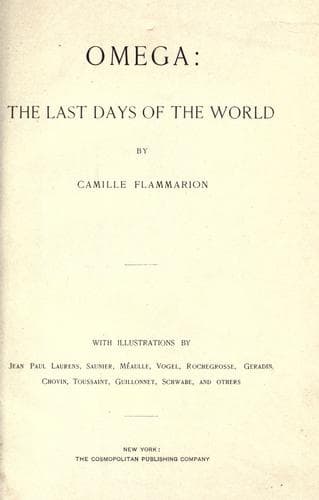
Omega: The Last days of the WorldFlammarion, Camille
Philosophy
Omega: The Last days of the World
Flammarion, Camille
End of the world -- Fiction; Science fiction
“The terrestrial globe being thus entirely surrounded by the cometary
mass for nearly seven hours, and revolving in this incandescent gas, the
air rushing violently toward the center of disturbance, the sea boiling
and filling the atmosphere with new vapors, hot showers falling from the
sky-cataracts, the storm raging everywhere with electric deflagrations
and lightnings, the rolling of thunder heard above the scream of the
tempest, the blessed light of former days having been succeeded by the
mournful and sickly gleamings of the glowing atmosphere, the whole earth
will speedily resound with the funeral knell of universal doom, although
the fate of the dwellers in the Antipodes will probably differ from that
of the rest of mankind. Instead of being immediately consumed, they will
be stifled by the vapors, by the excess of nitrogen—the oxygen having
been rapidly abstracted—or poisoned by carbonic-oxide; the fire will
afterwards reduce their corpses to ashes, while the inhabitants of
Europe and Africa will have been burned alive.
“The well-known tendency of carbonic-oxide to absorb oxygen will
doubtless prove a sentence of instant death for those farthest from the
initial point of the catastrophe.
“I have taken as an example the comet of 1811; but I hasten to add that
the present one appears to be far less dense.”
“Is it absolutely sure?” cried a well-known voice (that of an
illustrious member of the chemical society) from one of the boxes. “Is
it absolutely sure the comet is composed chiefly of carbonic-oxide? Have
not the nitrogen lines also been detected in its spectrum? If it should
prove to be protoxide of nitrogen, the consequence of its mixture with
our atmosphere might be anæsthesia. Every one would be put to
sleep—perhaps forever, if the suspension of the vital functions were to
last but a little longer than is the case in our surgical operations. It
would be the same if the comet was composed of chloroform or ether. That
would be an end calm indeed.
“It would be less so if the comet should absorb the nitrogen instead of
the oxygen, for this partial or total absorption of nitrogen would bring
about, in a few hours, for all the inhabitants of the earth—for men and
women, for the young and the aged—a change of temperament, involving at
first nothing disagreeable—a charming sobriety, then gayety, followed by
universal joy, a feverish exultation, finally delirium and madness,
terminating, in all probability, by the sudden death of every human
being in the apotheosis of a wild saturnalia, an unheard-of frenzy of
the senses. Would that death be a sad one?”
Public-domain text, read in full here on John Shaqi.
Reviews
Reviews
No reviews yet
Be the first to share your thoughts on this work.
Join the Discussion
Join the discussion
Sign in to leave a comment or review.
Sign InorCreate an account