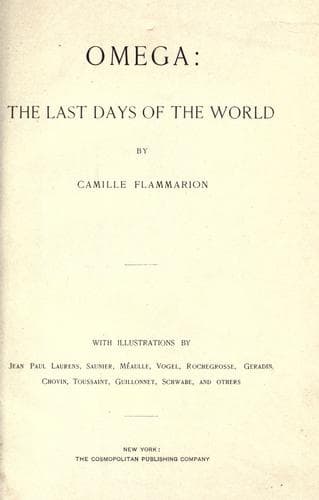
Omega: The Last days of the WorldFlammarion, Camille
Philosophy
Omega: The Last days of the World
Flammarion, Camille
End of the world -- Fiction; Science fiction
“The destruction of the globe by some great catastrophe is a dramatic
conception; far more so, certainly, than that of the action of the
forces now in operation, though they threaten our planet with a
destruction equally certain. Does not the stability of our continent
seem permanent? Except through the intervention of some new agency, how
is it possible to doubt the durability of this earth which has supported
so many generations before our own, and whose monuments, of the greatest
antiquity, prove that if they have come down to us in a state of ruin,
it is not because the soil has refused to support them, but because they
have suffered from the ravages of time and especially from the hand of
man? The oldest historical traditions show us rivers flowing in the same
beds as today, mountains rising to the same height; and as for the few
river-mouths which have become obstructed, the few land-slides which
have occurred here and there, their importance is so slight relatively
to the enormous extent of the continents, that it seems gratuitous
indeed to seek here the omens of a final catastrophe.
“Such might be the reasoning of one who casts a superficial and
indifferent glance upon the external world. But the conclusions of one
accustomed to scrutinize closely the apparently insignificant changes
taking place about him would be quite different. At every step, however
little skilled in observation, he will discover the traces of a
perpetual conflict between the external powers of nature and all which
rises above the inflexible level of the ocean, in whose depths reign
silence and repose. Here, the sea beats furiously against the shore,
which recedes slowly from century to century. Elsewhere, mountain masses
have fallen, engulfing in a few moments entire villages and desolating
smiling valleys. Or, the tropical rains, assailing the volcanic cones,
have furrowed them with deep ravines and undermined their walls, so that
at last nothing but ruins of these giants remain.
[Illustration:
THE SEA AT WORK.
]
[Illustration:
STREAM EROSION.
]
“More silent, but not less efficacious, has been the action of the great
rivers, as the Ganges and the Mississippi, whose waters are so heavily
laden with solid particles in suspension. Each of these small particles,
which trouble the limpidity of their liquid carrier, is a fragment torn
from the shores washed by these rivers. Slowly but surely their currents
bear to the great reservoir of the sea every atom lost to the soil, and
the bars which form their deltas are as nothing compared with what the
sea receives and hides away in its abysses. How can any reflecting
person, observing this action, and knowing that it has been going on for
many centuries, escape the conclusion that the rivers, like the ocean,
are indeed preparing the final ruin of the habitable world?
Public-domain text, read in full here on John Shaqi.
Reviews
Reviews
No reviews yet
Be the first to share your thoughts on this work.
Join the Discussion
Join the discussion
Sign in to leave a comment or review.
Sign InorCreate an account