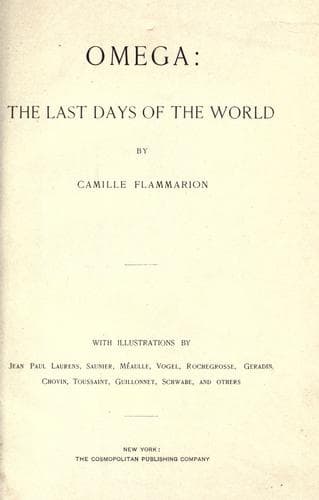
Omega: The Last days of the WorldFlammarion, Camille
Philosophy
Omega: The Last days of the World
Flammarion, Camille
End of the world -- Fiction; Science fiction
For about 300 years the observatory of Paris had ceased to be an
observing station, and had been perpetuated only as the central
administrative bureau of French astronomy. Astronomical observations
were made under far more satisfactory conditions upon mountain summits
in a pure atmosphere, free from disturbing influences. Observers were
in direct and constant communication by telephone with the central
office, whose instruments were used only to verify certain discoveries
or to satisfy the curiosity of savants detained in Paris by their
sedentary occupation.
“A telescopic comet discovered tonight, in 290°, 15´ right ascension,
and 21°, 54´ south declination. Slight diurnal motion. Is of greenish
hue.”
Not a month passed without the discovery of telescopic comets, and
their announcement to the various observatories, especially since the
installation of intrepid astronomers in Asia on the lofty peaks of
Gaurisankar, Dapsang and Kanchinjinga; in South America, on Aconcagua,
Illampon and Chimborazo, as also in Africa on Kilimanjaro, and in
Europe on Elburz and Mont Blanc. This announcement, therefore, had not
excited more comment among astronomers than any other of a like nature
which they were constantly receiving. A large number of observers had
sought the comet in the position indicated, and had carefully followed
its motion. Their observations had been published in the
Neuastronomischenachrichten, and a German mathematician had calculated
a provisional orbit and ephemeris.
Scarcely had this orbit and ephemeris been published, when a Japanese
scientist made a very remarkable suggestion. According to these
calculations, the comet was approaching the sun from infinite space in a
plane but slightly inclined to that of the ecliptic, an extremely rare
occurrence, and, moreover, would traverse the orbit of Saturn. “It would
be exceedingly interesting,” he remarked, “to multiply observations and
revise the calculation of the orbit, with a view to determining whether
the comet will come in collision with the rings of Saturn; for this
planet will be exactly at that point of its path intersected by the
orbit of the comet, on the day of the latter’s arrival.”
[Illustration:
THE YOUNG LAUREATE.
]
Public-domain text, read in full here on John Shaqi.
Reviews
Reviews
No reviews yet
Be the first to share your thoughts on this work.
Join the Discussion
Join the discussion
Sign in to leave a comment or review.
Sign InorCreate an account