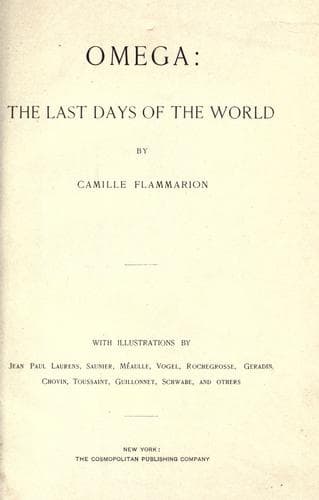
Omega: The Last days of the WorldFlammarion, Camille
Philosophy
Omega: The Last days of the World
Flammarion, Camille
End of the world -- Fiction; Science fiction
As to the dogma “Credo Resurrectionem Carnis,” the addresses of the
fathers of the Church before the council assembled in the Sistine chapel
at Rome, were, on the whole, in accord with the opinion expressed by the
cardinal archbishop of Paris. The clause “et vitam æternam” was tacitly
ignored, in view of the possible discoveries of astronomy and
psychology. These addresses epitomized, as it were, the history of the
doctrine of the end of the world as held by the Christian Church in all
ages.
This history is interesting, for it is also the history of the human
mind face to face with its own destiny, and we believe it of sufficient
importance to devote to it a separate chapter. For the time being,
therefore, we abandon our role as the chronicler of the twenty-fourth
century, and return to our own times, in order to consider this doctrine
from an historical point of view.
The existence of a profound and tenacious faith is as old as the
centuries, and it is a notable fact that all religions, irrespective of
Christian dogma, have opened the same door from this mortal life upon
the unknown which lies beyond, it is the door of the Divine Comedy of
Dante, although the conceptions of paradise, hell and purgatory peculiar
to the Christian Church, are not universal.
Zoroaster and the Zend-Avesta taught that the world would perish by
fire. The same idea is found in the Epistle of St. Peter. It seems that
the traditions of Noah and of Deucalion, according to which the first
great disaster to humanity came by flood, indicated that the second
great disaster would be of an exactly opposite character.
The apostles Peter and Paul died, probably, in the year 64, during the
horrible slaughter ordered by Nero after the burning of Rome, which had
been fired at his command and whose destruction he attributed to the
Christians in order that he might have a pretext for new persecutions.
St. John wrote the Apocalypse in the year 69. The reign of Nero was a
bloody one, and martyrdom seemed to be the natural consequence of a
virtuous life. Prodigies appeared on every hand; there were comets,
falling stars, eclipses, showers of blood, monsters, earthquakes,
famines, pestilences, and above all, there was the Jewish war and the
destruction of Jerusalem. Never, perhaps, were so many horrors, so much
cruelty and madness, so many catastrophes, crowded into so short a
period as in the years 64–69 A.D. The little church of Christ was
apparently dispersed. It was impossible to remain in Jerusalem. The
horrors of the reign of terror of 1793, and of the Commune of 1871, were
as nothing in comparison with those of the Jewish civil war. The family
of Jesus was obliged to leave the holy city and to seek safety in
flight. False prophets appeared, thus verifying former prophecies.
Vesuvius was preparing the terrible eruption of the year 79, and
already, in 63, Pompeii had been destroyed by an earthquake.
Public-domain text, read in full here on John Shaqi.
Reviews
Reviews
No reviews yet
Be the first to share your thoughts on this work.
Elsewhere in the archive
Join the Discussion
Join the discussion
Sign in to leave a comment or review.
Sign InorCreate an account